The London Underground operates through 11 colour-coded lines covering over 400 kilometres and 272 stations across nine fare zones. Passengers use Oyster cards or contactless payments to tap in and out at stations. Before travel, checking the Tube map or journey planner app helps identify correct lines, directions, and interchanges. Observing platform safety by standing behind yellow lines and following signs guarantees smooth boarding. For extensive details on traversing, fare options, and etiquette, further information is available.
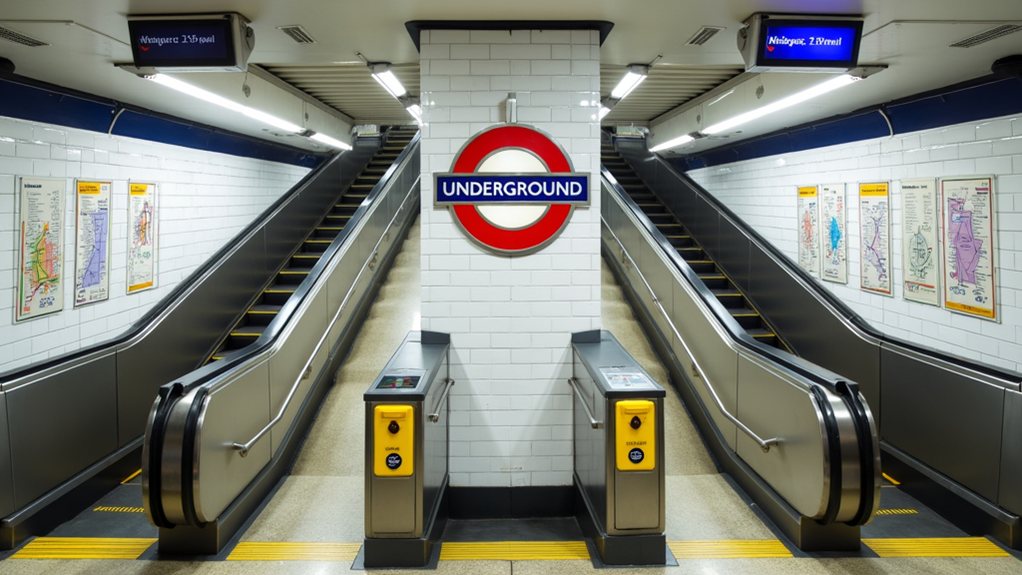
Although the London Underground is a complex transit system, understanding its structure and operations can simplify travel across the city. The network consists of 11 colour-coded lines that cover more than 400 kilometres of track and include 272 stations. It is divided into nine fare zones, with Zone 1 covering Central London and zones extending outward toward the city’s edges. The Tube carried 1.181 billion passenger journeys in 2023/24, demonstrating its vital role in London’s daily transport.
The London Underground features 11 colour-coded lines across 272 stations and nine fare zones for navigating the city.
The Tube map is an essential tool for guidance; physical copies are available for free at stations, and digital versions can be downloaded from the Transport for London (TfL) website. Key interchange stations enable passengers to transfer between lines and reach various destinations effectively. Digital screens on platforms display arrival times and route endpoints, helping travellers confirm train direction and current service status before boarding. Many travelers find it helpful to download apps like Tube Map and Citymapper to have offline assistance readily available during their journey. Additionally, knowing the major attractions connected by the Tube can enhance your travel experience.
Before entering the station, it is advisable to review the Tube map to understand line colours, stops, and transfer points. This preparation reduces confusion when underground. Journey planner apps like TfL Go or Citymapper provide real-time assistance and suggest ideal routes. The term “The Tube” originated in the early 1900s, referring to the shape of its tunnels, which is a helpful historical fact to appreciate the system’s design.
On the platform, passengers should identify the direction of travel—northbound, southbound, eastbound, or westbound—using signs and digital displays. Checking the train endpoints is particularly important where lines split and services diverge from the same platform. Planning interchanges ahead guarantees that passengers do not miss connecting trains or spend extra time maneuvering between platforms.
Once inside the station, travellers should follow the prominent signage indicating line colours, directions, exits, ticket machines, and facilities. The iconic roundel symbol marks entrances clearly. Escalator etiquette requires standing on the right side to allow others to pass on the left. Staying behind the yellow safety line on platforms and moving along to board where space is available is important for safety and efficiency. Warnings such as “Mind the gap” alert passengers to the gap between train and platform. The London Underground is regarded as one of the safest transport systems globally, with CCTV and staff presence ensuring passenger security.
For fare payment, passengers must tap an Oyster card, contactless payment card, or mobile device on yellow card readers at the start and end of each journey to verify the correct fare is charged. Forgetting to tap out results in maximum fare charges. Cards should be ready before reaching turnstiles to avoid delays.
Oyster cards can be topped up at machines inside stations. Contactless users benefit from daily fare capping, which limits the maximum spend when using the same card throughout the day. Pricing is based on journey length rather than a flat fee, with the network divided into zones where Zone 1 is central London and Zone 6 the outskirts.
When boarding, passengers should allow others to exit the train first to maintain flow and prevent crowding. Moving down inside the carriage creates more space for new passengers boarding at later stops. These guidelines help guarantee a smooth and efficient journey on the London Underground.
Frequently Asked Questions
Are There Restrooms Available on London Underground Stations?
Restrooms are available at certain London Underground stations but are limited, especially in central areas.
Most toilets are found at larger or suburban stations such as Baker Street, Heathrow terminals, and Wimbledon. Some restrooms require ticket access and may close outside staff hours.
Facilities include baby changing and accessible toilets, with some offering Changing Places for disabled users.
Transport for London manages these amenities and provides maps to help locate them.
Can I Bring Bicycles on the London Underground?
Folded bicycles are allowed on all London Underground lines at any time, treated as luggage without extra charges, but must be carried by the passenger and fit size limits.
Non-folding bikes are only permitted outside peak hours and on certain lines, with some sections entirely prohibiting them.
Bikes cannot be taken on moving escalators, so passengers should use lifts or step-free access.
Staff may restrict bike carriage during busy periods for safety.
What Are the Rules for Traveling With Pets on the Tube?
Traveling with pets on the Tube requires dogs to be on a short lead, in a bag, or crate, while small pets must be in secure carriers.
Assistance dogs have no restrictions. Pets cannot roam freely or sit on seats.
Owners should avoid rush hours, carry water, and use accessibility gates.
Aggressive or poorly behaved animals may be refused entry, and dogs should be microchipped with identification tags for safety and compliance.
Is There Wi-Fi Available on London Underground Trains?
Wi-Fi is not available on London Underground trains while they travel underground, as signals do not reach tunnels.
However, Wi-Fi is accessible at all Underground stations, allowing devices to connect once the train arrives at a platform.
On above-ground sections of the Elizabeth line, some trains offer on-board Wi-Fi.
Mobile network coverage with 4G and 5G is expanding across many tunnels and stations, enabling internet use on certain underground segments.
How Do I Report Lost Property on the Tube?
Lost property on the Tube should be reported using Transport for London’s official online lost property enquiry form, providing detailed descriptions and unique identifiers like IMEI for electronics.
After submission, further contact by phone or email is unnecessary, as responses are managed online and may take up to 15 days.
Items found are stored for two weeks at the Lost Property Office in South Kensington, available for collection by appointment only.