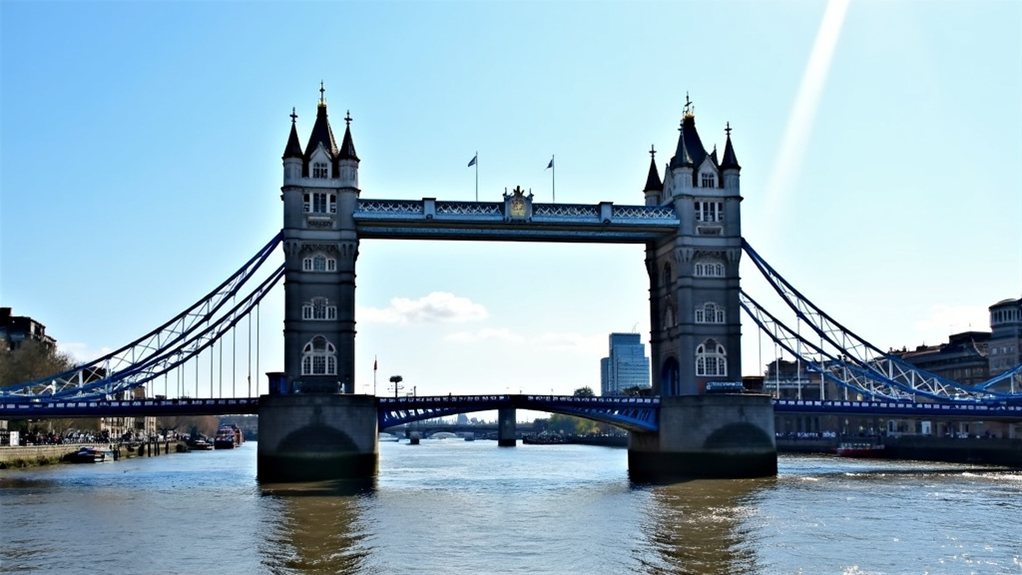
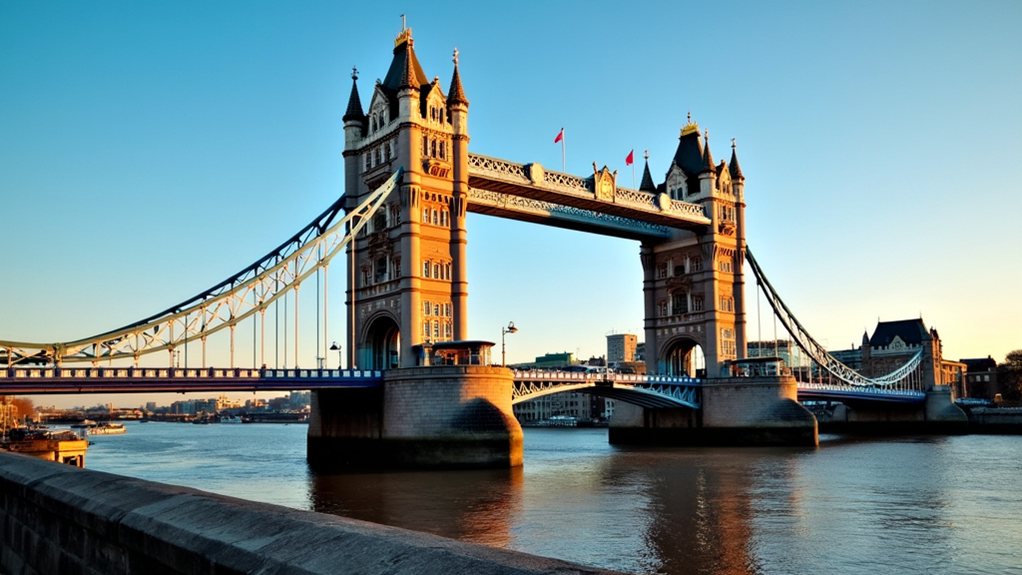
Tower Bridge, completed in 1894, is a combined bascule and suspension bridge with iconic Gothic towers. It was engineered with a hydraulic lifting system, now electric, to allow ship passage. Visitors can purchase tickets to access the high-level walkways and engine rooms, offering insights into its history and mechanics. The bridge remains an essential crossing and popular tourist site in London. Additional details cover the construction and visitor experience ahead.
Tower Bridge, an iconic structure spanning the River Thames in London, was designed to address the increasing traffic and commercial needs of the late 19th century. By 1876, the City of London Corporation recognized the demand for a new crossing east of the Tower of London. To find a suitable design, a Special Bridge or Subway Committee launched a competition that attracted over 50 entries, but none were selected as a winner. On 10 February 1876, a formal petition was submitted to emphasize the urgency of the project.
Tower Bridge was conceived in the late 19th century to meet growing traffic and commercial demands east of the Tower of London.
In November 1884, architect Sir Horace Jones and engineer Sir John Wolfe Barry proposed a bascule bridge design that combined Gothic towers with a central opening mechanism. This design allowed ships to pass while maintaining road traffic and introduced a hydraulic system to power the bascules, a novel feature at the time. Parliament approved the project through the Tower Bridge Act of August 1885, which authorized construction and regulated the bridge’s use. The design also featured Gothic towers and an arched span, blending aesthetics with engineering innovation. The bridge has since become a symbol of London, drawing millions of visitors each year who come to witness its historic significance.
Construction began on 22 April 1886 under Chief Engineer Sir John Wolfe Barry, with support from Henry Marc Brunel and Edward Cruttwell. The project included five major contractors and about 432 laborers working daily. The building process required 11,000 tons of steel, 70,000 tons of concrete, and 22,000 liters of paint. Skilled divers were employed to work on the underwater foundations, earning £10 a minute for their dangerous task. Horace Jones passed away during construction, leaving Barry to lead the project.
Divers, who earned high wages for their time, worked on the underwater foundations, reflecting the complexity of the construction. The total cost was approximately £1.2 million, equivalent to over £140 million today.
Tower Bridge is a combined bascule and suspension bridge, with two large towers connected by walkways. The bascules are counterbalanced for quick lifting, originally powered by steam-driven hydraulic systems and later converted to electric power in 1974.
The foundations needed extensive engineering efforts due to their riverbed location. The bridge’s design blends functionality with Victorian Gothic architectural details, complementing the nearby Tower of London. It was formally opened on 30 June 1894 by the Prince and Princess of Wales in a significant ceremony attended by dignitaries, marking a milestone in London’s history.
Frequently Asked Questions
Are There Guided Tours Available at Tower Bridge?
Guided tours are available at Tower Bridge, primarily in the mornings, requiring advance booking due to limited spaces.
Standard tours last about 1.5 hours and include visits to the Towers, High-Level Walkways, Glass Floors, and Engine Rooms.
Private and Behind-the-Scenes tours, with specific requirements and costs, also exist.
Visitors must pre-book tickets, which are released eight weeks in advance, and allow extra time for security checks before tours begin.
Is Tower Bridge Wheelchair Accessible?
Tower Bridge is wheelchair accessible, with step-free access to walkways and engine rooms via lifts in both towers.
Accessible toilets and grab bars are provided, and wheelchairs or walking aids can be borrowed on-site. The glass floor walkway is fully accessible.
Some lift closures, particularly at the south tower, may require alternative routes.
Public transport options, including the nearby Tower Gateway DLR station and accessible buses, facilitate arrival for wheelchair users.
Can I Book Private Events at Tower Bridge?
Private events can be booked at Tower Bridge, offering spaces like the High-Level Walkways and The Engine Rooms.
These venues accommodate various occasions, including weddings, corporate functions, and parties. Capacities range from 120 seated to 400 standing guests, depending on the space.
Booking requires contacting Tower Bridge Events directly, with fees starting around £1,765.
Additional services like catering, styling, and planning support are available to customize events efficiently.
Are Photography and Filming Allowed Inside Tower Bridge?
Photography inside Tower Bridge is allowed using handheld cameras and smartphones, including flash photography, but tripods and standing equipment are prohibited to avoid obstruction.
Commercial filming requires prior permission from the City of London Film Team, with fees and contracts involved. Visitors must respect others’ privacy and not block pathways.
Professional shoots need licensing due to ownership complexities. Early morning or late afternoon offer better natural light for outdoor shots, while indoor photography should be handheld and unobtrusive.
What Are the Nearest Public Transport Options to Tower Bridge?
The nearest public transport options to Tower Bridge include London Bridge station, serving National Rail and Underground lines with step-free access and direct links to Gatwick Airport.
Tower Hill Underground station, on the District and Circle lines, is a short walk with step-free access.
Bus routes 15, 42, 78, 100, and 343 stop close by.
Riverboat services operate from Tower Pier and London Bridge City Pier, providing scenic Thames connections.