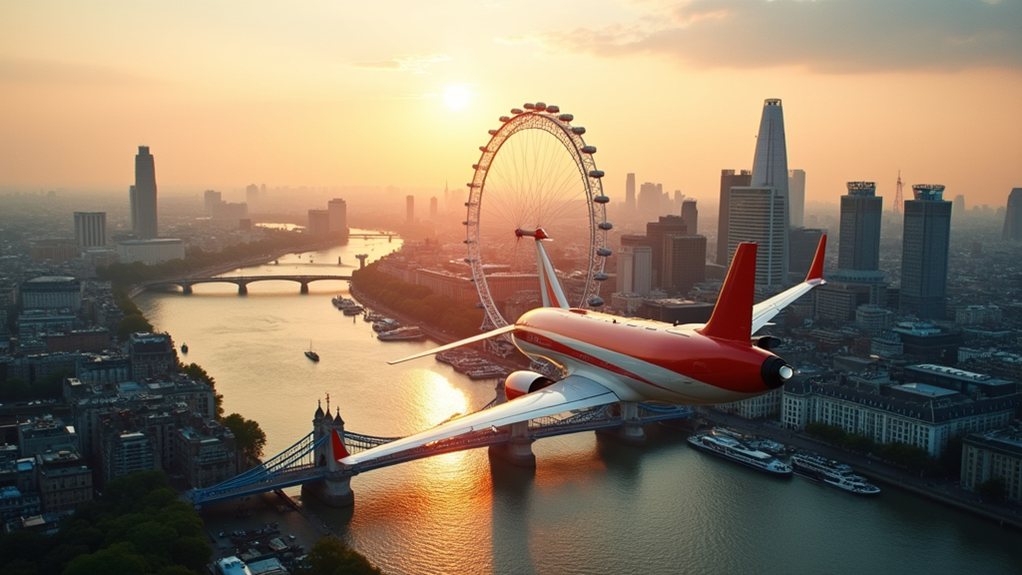
Traveling between New York and London, two of the world’s most iconic cities, currently takes approximately 7 hours on a typical transatlantic flight covering 5,539 kilometers. With 21 direct flights operating daily between these metropolises, travelers have numerous options but still face considerable travel time, including the average commute times of 45.5 minutes in New York and 46 minutes in London.
A revolutionary concept aims to dramatically reduce this travel time: a proposed vacuum tube tunnel spanning 3,400 miles beneath the Atlantic Ocean. This ambitious project could potentially slash the journey to just 54 minutes by eliminating air resistance and friction. The estimated cost reaches a staggering $19.8 trillion, equivalent to China’s entire GDP, making it one of the most expensive infrastructure projects ever conceived.
Industry insiders suggest Elon Musk, known for his Hyperloop concept, could lead this transformative project. While challenging in scale, the tunnel would function similarly to the existing 23.5-mile Channel Tunnel but on a vastly larger scale. The Boring Company, founded in 2017, has completed three projects including the Las Vegas Loop which demonstrates the potential for underground transportation systems. The frictionless environment would allow unprecedented travel speeds between the continents.
This mega-tunnel isn’t the only innovation challenging conventional travel times. Venus Aerospace’s Stargazer hypersonic jet aims to connect these cities in under one hour, flying at six times the speed of sound using its specialized VDR2 engine at an altitude of 110,000 feet. The experience would allow passengers to witness the curvature of Earth during their journey. Meanwhile, Boom Supersonic’s Overture promises to reduce the journey to 3.5 hours by 2029, having secured orders from major airlines including United and Japan Airlines. Advanced online booking is recommended as these innovative travel options could offer special fares for different categories of travelers.
If realized, the tunnel would greatly impact existing flight routes. Direct flights from regional hubs like Newark, Philadelphia, and Boston to London would likely see reduced demand, as would routes connecting New York to Paris, Scotland, and Ireland.
The project represents a paradigm shift in international travel, potentially transforming business, tourism, and global connectivity while establishing a new benchmark for sustainable, ultra-rapid transit between continents.