
Hidden beneath a stunning glass and steel canopy, Europe’s largest covered public square quietly welcomes millions of visitors each year at the heart of the British Museum in London. The Great Court spans an impressive two acres, offering a bright, airy space that serves as the central hub connecting the museum’s vast collection of galleries. Over 60 galleries grouped by world regions and historical periods showcase the museum’s diverse collections.
Originally designed as a garden by Robert Smirke in 1852, this area later housed the museum’s library department, including the famous Reading Room where notable figures like Bram Stoker, Arthur Conan Doyle, and Lenin once studied.
Following the British Library‘s relocation to St Pancras in 1997, the space underwent a remarkable transformation. The Foster and Partners architectural firm, working with engineers from Buro Happold, designed an innovative roof structure consisting of 3,212 uniquely shaped glass panes. No two panes are identical, creating a tessellated pattern that filters ultraviolet rays while allowing natural light to flood the space below.
The undulating glass roof is supported by 4,878 distinct steel members connected at 1,566 nodes, an engineering marvel constructed by Austrian firm Waagner-Biro.
Queen Elizabeth II officially opened the Great Court on December 6, 2000, revealing a space that increased the museum’s public areas by approximately 40%. The ground level was raised one story above the original courtyard, creating room underneath for the Clore Education Centre and African galleries. The choice of materials sparked controversy when French stone was used instead of the originally agreed Portland stone from southern England.
At the center stands the preserved circular Reading Room, now repurposed for exhibitions while maintaining its historical significance.
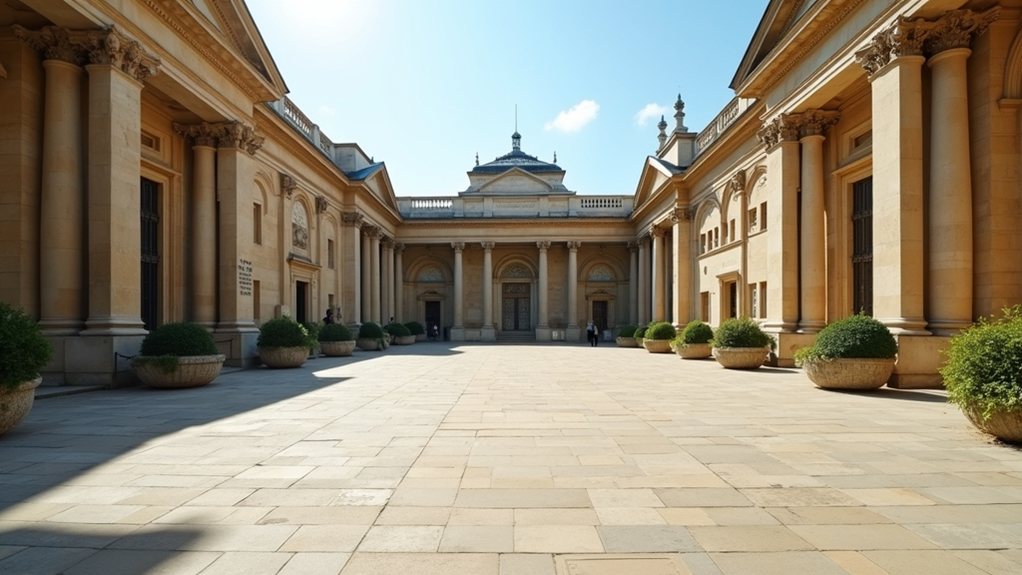
Visitors can freely explore this magnificent space, as the Great Court is open daily with no admission charge. The museum, established in 1753, represents the first national museum open to the public in the world with a mission of collecting everything. The square houses sculptures representing diverse cultures, from Ireland to Ming Dynasty China and ancient Nimrud. During periods of high traffic, visitors might experience longer wait times for certain exhibits, though the spacious design helps minimize congestion.
As visitors navigate between the museum’s galleries, which display only about 1% of the institution’s eight million objects, the Great Court provides a central orientation point and resting area. This architectural achievement transformed what was once restricted space into an accessible public square within one of the world’s most renowned museums.