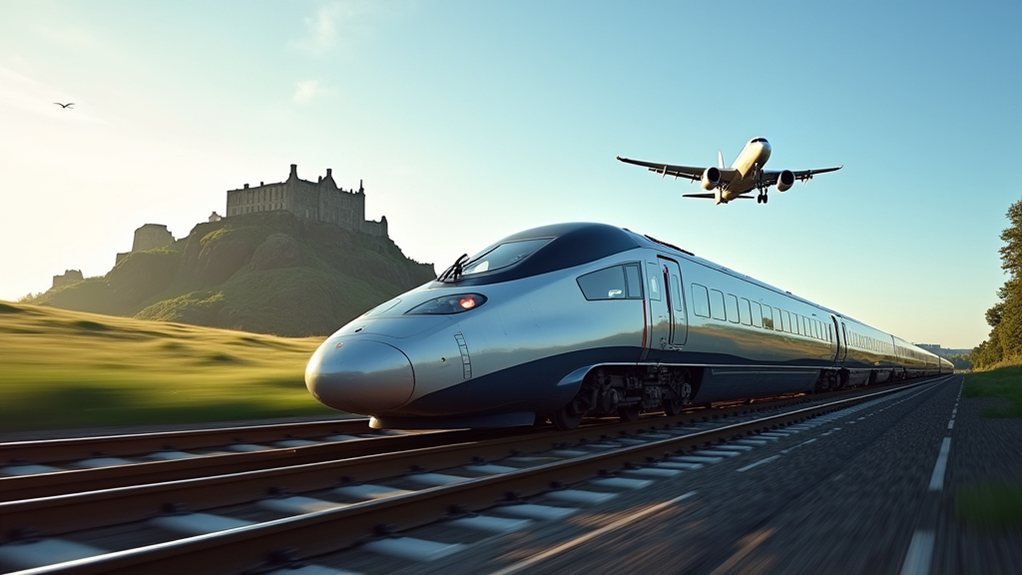

In a unique challenge aimed at comparing travel times, a man tested his speed against that of a plane and a train on the route from Edinburgh to London. The distance between these two cities is approximately 400 miles, or 644 kilometers. This challenge was designed to highlight the differences in travel efficiency among various modes of transportation.
Typically, a flight from Edinburgh to London takes around 1.5 hours, but this time does not include airport procedures, such as check-in and security checks, which can add significant time. On the other hand, a direct train journey along the East Coast Main Line usually takes about 4.5 hours. This means that, under normal circumstances, a plane is the fastest option available for this route.
The man’s challenge raised interesting questions about how speed and efficiency are perceived in urban transportation. Even when considering faster planes, such as the retired Concorde, which could travel at supersonic speeds, the comparison still holds. Since the Concorde was retired in 2003, modern commercial air travel does not match its speed, making the challenge particularly relevant today.
This endeavor not only underscored the varying travel times but also opened up discussions about the impact of technology on transportation methods. As people increasingly seek quicker ways to travel, understanding the pros and cons of each option becomes essential. Additionally, factors like fare zones can affect the overall cost and convenience of train travel compared to flying.
The challenge serves as a reminder that while planes are generally faster, the overall travel experience might differ based on the mode chosen. Ultimately, this speed duel between the man, the plane, and the train illustrates the ongoing debates about efficiency in travel. In a world where time is often equated with value, such comparisons can influence how individuals plan their journeys across significant distances like that from Edinburgh to London.