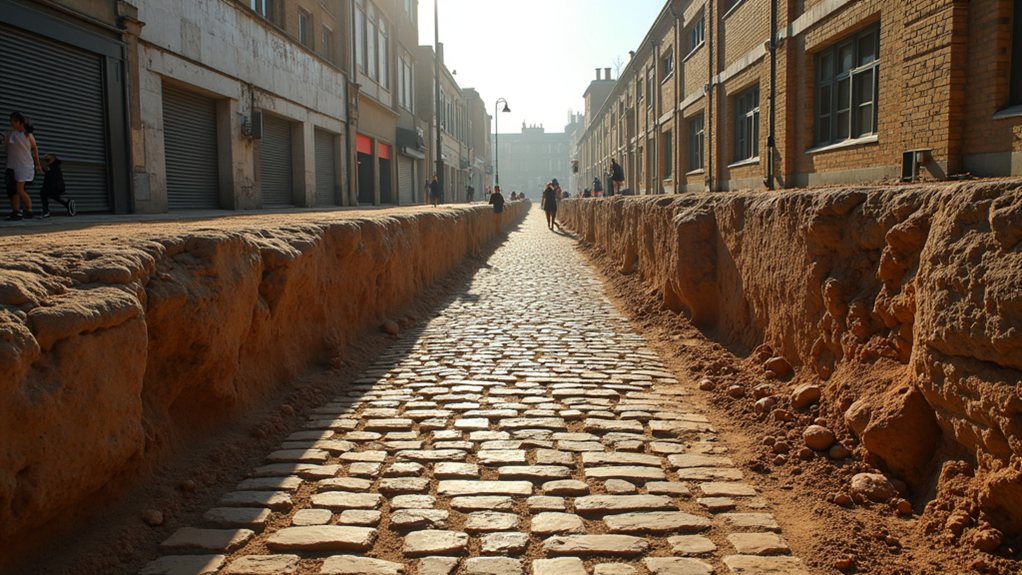
While excavating for a low-carbon heat network in Southwark, archaeologists have uncovered a remarkably preserved section of Roman road beneath London’s busy Old Kent Road. The discovery was made by a Museum of London Archaeology (MOLA) team working on behalf of Veolia and RPS at the junction of Old Kent Road and Ilderton Road.
The ancient road section measures 5.8 metres wide by 1.4 metres high, with its full length still unknown. This ancient thoroughfare, known as Watling Street, was built shortly after the Roman invasion in AD 43 and stretched 444 kilometers from the West Midlands to Dover port.
Despite nearly 2,000 years of urban development, including sewers, power cables, tramlines, and modern roadworks, the Roman road has survived largely intact. This marks the first physical proof that the ancient route lies directly beneath the modern Old Kent Road.
After two millennia of urban development, this ancient Roman highway remains remarkably preserved beneath London’s bustling thoroughfare.
The excavation revealed the road’s sophisticated construction, featuring a solid foundation of compacted gravel sealed by two layers of chalk and topped with compacted sand and gravel. The modern road base now rests directly on this Roman fabric, as the original surface has been lost over time. These distinct layers provide valuable insights into Roman construction techniques.
Previous archaeological work had uncovered portions of Roman road surfaces at Cantium Retail Park to the northwest and evidence of gravel quarrying likely used for the road’s construction at 610 Old Kent Road in 2006. The new discovery confirms that the Roman road runs under the modern alignment from the Lewisham border to Cantium Retail Park.
Dave Taylor, MOLA project manager, described the find as an “amazing survival,” while Dr. Chris Constable, Southwark archaeology officer, confirmed the road’s preservation throughout the borough. The discovery has redrawn the Roman road map for Southwark and provides essential information about this significant artery used by emperors like Hadrian during his visit to Britain in AD 122. Following the Roman Empire’s collapse, Anglo-Saxons renamed the impressive roadway to Roxetta Wling, which eventually evolved into Watling. A commemorative plaque will be installed on the Old Kent Road bridge to mark this important archaeological discovery.