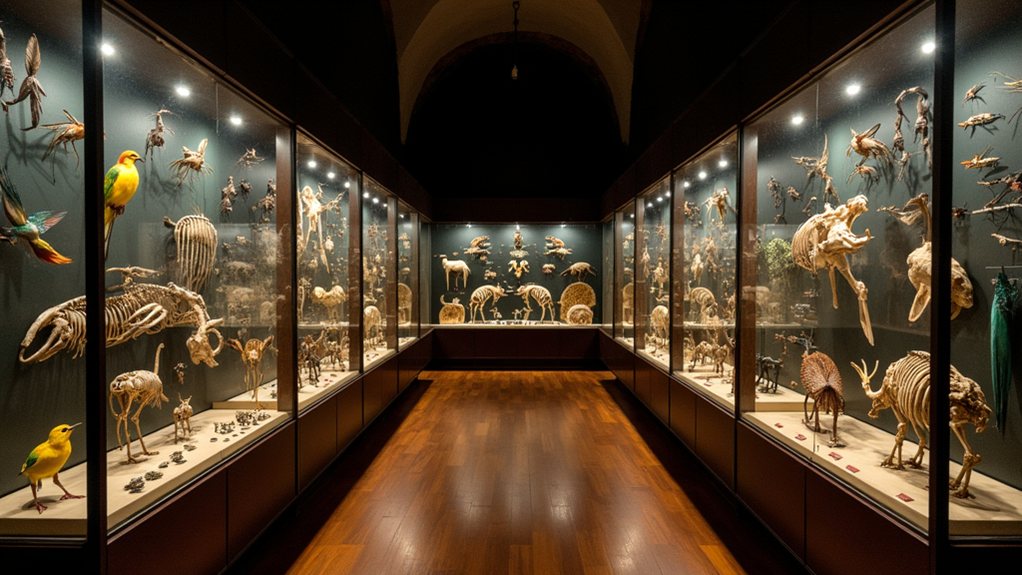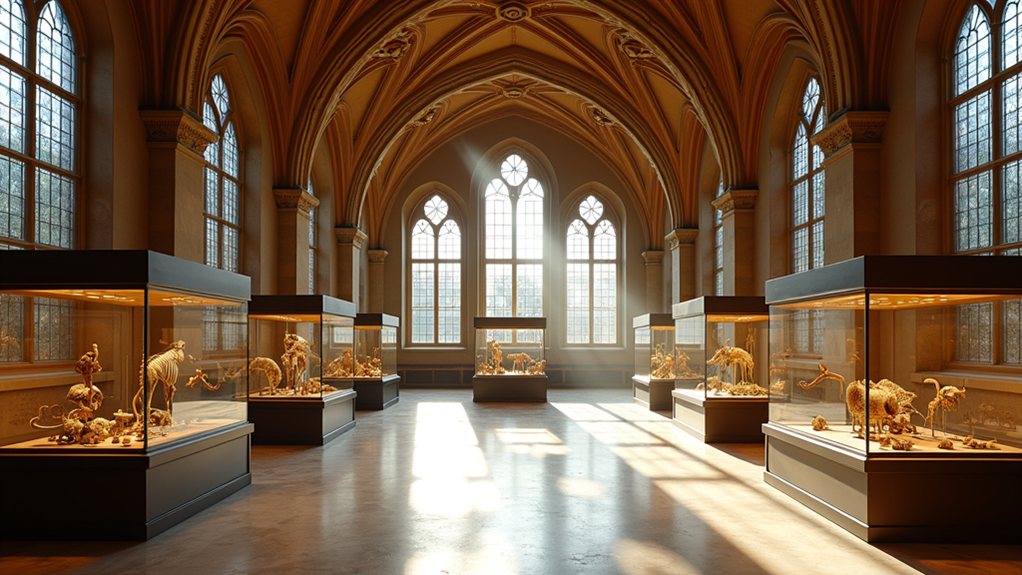

The Natural History Museum’s Treasures Gallery has reopened with a stunning display that spans 4.6 billion years of Earth’s history through just 22 carefully selected objects.
Located in the Cadogan Gallery, these exhibits represent the scientific, historical, aesthetic, and cultural importance found within the museum’s vast collection of over 70 million specimens.
The gallery serves as a concentrated showcase of Earth’s most remarkable natural artifacts, allowing visitors to experience key moments in our planet’s development.
In this extraordinary space, nature’s masterpieces tell Earth’s epic story through carefully curated moments of planetary significance.
Among the twelve key highlights is a royal lion skull from the Tower of London menagerie, which stands as a symbol of the English monarchy’s 800-year history.
The gallery also features moon rock, meteorites, and the famous Winchcombe meteorite that was discovered in a field.
Darwin’s pigeons, which helped formulate his theory of evolution, are displayed alongside a first edition of “On the Origin of Species.”
The historical significance of the collection is anchored by Hans Sloane’s nautilus shell from the 18th century, which formed the basis of the museum when his collection was purchased in 1753.
Initially housed in Montagu House, these specimens have educated the public for centuries.
Richard Owen, who founded the museum, analyzed key fossils including the moa skeleton, which he identified in 1839 as an extinct flightless bird from a single bone fragment.
Scientific treasures include the exquisite Blaschka glass models of marine invertebrates, created between 1876-1889 using techniques that cannot be replicated today.
The collection also features an Archaeopteryx fossil and an Iguanodon specimen that contributed to the coining of the term “dinosaurs” by Richard Owen.
The gallery’s revival connects visitors with London’s history, from the Thames to the Tower of London.
With specimens ranging from William Smith’s ammonites to emperor penguin eggs collected to study embryonic development, the Treasures Gallery offers an extensive yet focused journey through natural history that has literally shaken world views throughout time. Visitors should note that “Natural History Museum” can refer to numerous institutions worldwide, so confirming the London location is important when planning a visit.
The emperor penguin eggs on display represent an extraordinary scientific expedition where team members endured extreme Antarctic conditions while collecting samples to investigate the evolutionary connection between birds and reptiles.
Visitors experiencing website access issues should contact the museum directly as some online resources may be temporarily restricted for security due to protection measures implemented by Barracuda Networks.