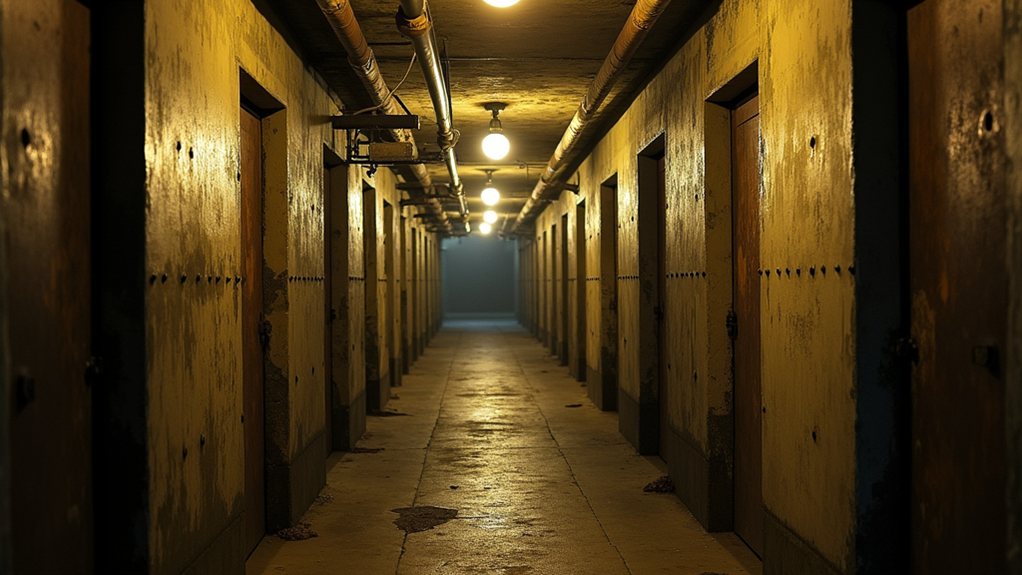
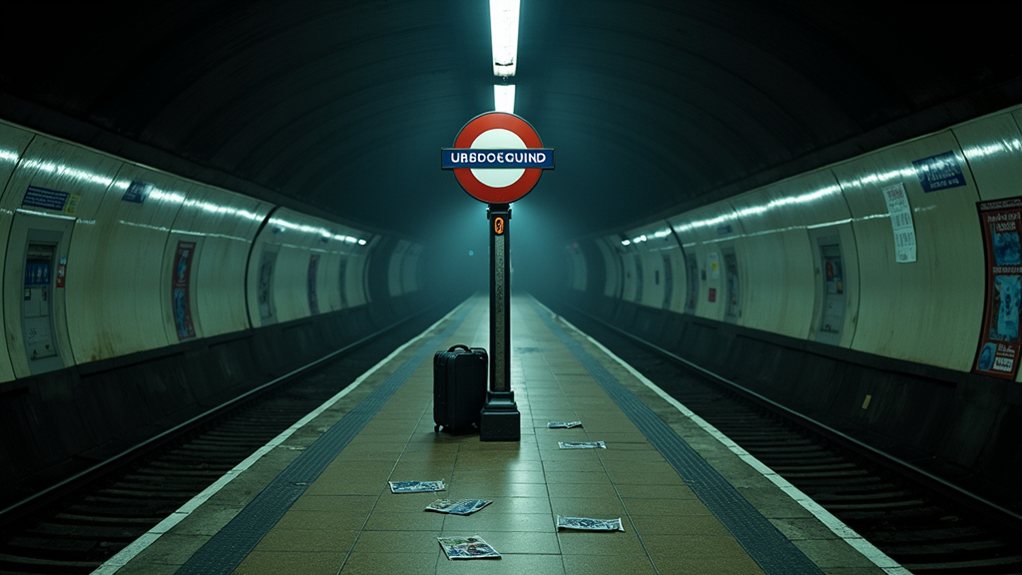
While London endured the devastating bombing raids of World War II, an extraordinary network of protection was being constructed deep beneath its streets. Between 1940 and 1942, workers excavated two parallel concrete tunnels beneath Goodge Street station, creating one of London’s most significant deep-level shelters. Each tunnel stretched approximately 1,200 feet in length with an internal diameter of about 16.6 feet, designed to withstand the German bombing campaign known as the Blitz.
As bombs fell on London, engineers carved a hidden sanctuary beneath Goodge Street—twin concrete tunnels built to outlast the Blitz.
The shelter’s innovative design featured two decks within each tunnel, maximizing the available space to accommodate roughly 8,000 people. Engineers outfitted the facility with tiered bunks, medical posts, kitchens, and toilets to support extended stays underground. Separate access shafts and ventilation systems guaranteed fresh air circulation and provided multiple entry and exit points.
By late 1942, part of the Goodge Street shelter was converted to serve as headquarters for General Dwight D. Eisenhower during the critical planning phase for D-Day operations. The remaining sections were adapted for government offices and provided billet space for American and British troops. Military planners selected this location due to its deep-level protection and convenient proximity to central London’s infrastructure.
Unlike some of the other deep shelters built during this period, Goodge Street remained primarily in official use rather than opening to civilians. When V-weapon attacks intensified in 1944, five of the eight deep shelters welcomed the public, while Goodge Street continued serving military and government functions. Similar deep-level shelters were also constructed at other underground stations including Clapham South, Clapham Common, and Camden Town.
After the war, the facility operated as an army transit center until a significant fire in May 1956 damaged the structure and limited its large-scale use. The shelter later gained cultural recognition when it was featured in the 1968 BBC Doctor Who story “The Web of Fear.”
Today, evidence of this remarkable underground complex remains visible at street level, with entrance features still present. The Luftwaffe bombing raids that killed over 43,500 civilians made such shelters a critical component of Britain’s wartime civil defense strategy. The Goodge Street shelter represents an important chapter in London’s wartime history, demonstrating the ingenuity and resilience shown in protecting both military operations and civilian life during Britain’s darkest hours.