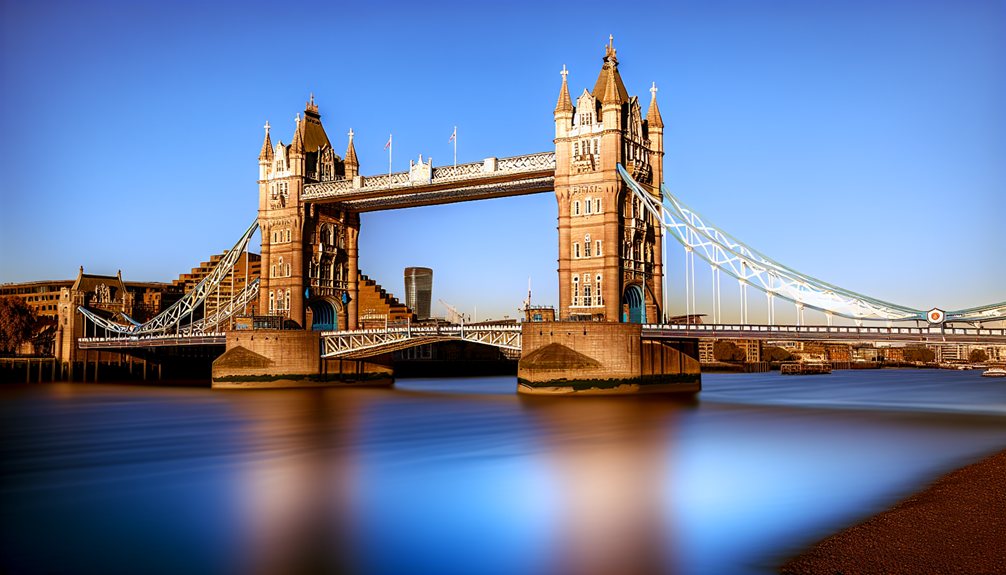

Tower Bridge, opened in 1894, is a stunning Victorian landmark featuring Gothic-style twin towers and a unique bascule design that lifts for tall ships. Visitors can explore its glass walkways, enjoy panoramic views, and learn about its engineering feats, like its steel frame and electro-hydraulic lifting system. Tickets grant access to exhibitions and the bridge’s history. For those intrigued by its dramatic past and continued significance, there’s plenty more fascinating detail ahead.
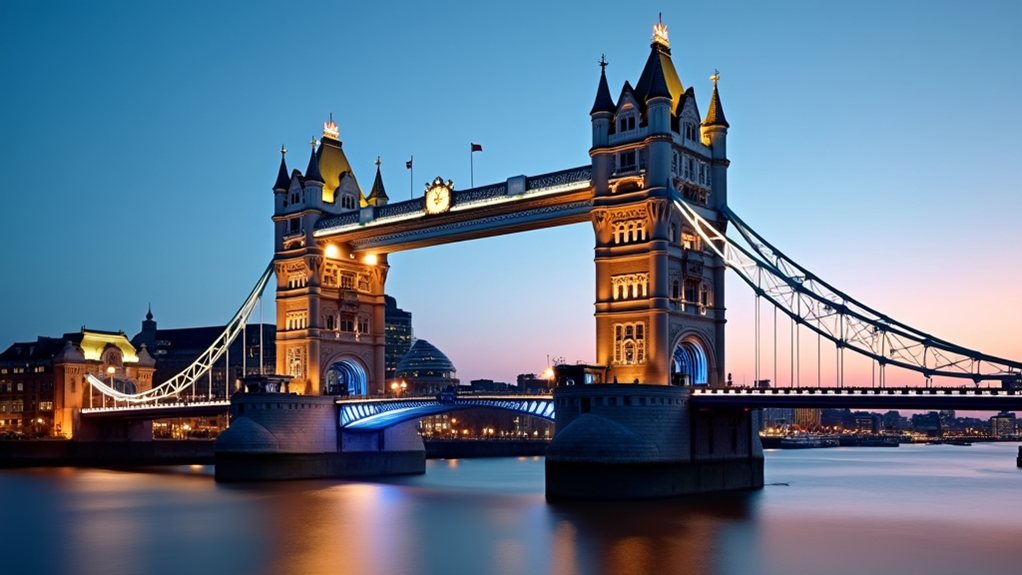
Although Tower Bridge is often mistaken for the oldest crossing over the Thames, it was actually built in the late 19th century to ease traffic congestion near London Bridge. In the 1870s, East London faced serious traffic jams, prompting the City of London to establish a Special Bridge Committee in 1876 to find a solution. Over 50 design proposals flooded in, reflecting the challenge of creating a bridge that not only carried heavy traffic but also allowed tall-masted ships to access the busy Pool of London docks. Since the bridge would affect navigation and major city routes, parliamentary approval was essential before construction could begin.
The winning design, adopted in 1884, was a clever mix of bascule and suspension bridge elements, masterminded by architect Sir Horace Jones and civil engineer Sir John Wolfe Barry. The bridge’s two central bascules could be raised to let ships pass, which was quite the engineering feat back then. To blend with the nearby historic Tower of London, the bridge featured Gothic-style twin towers clad in stone, creating an iconic and monumental look. The Tower Bridge Act of 1885 set the rules for how the bridge would be built and operated, ensuring a smooth process. Skilled divers were employed to build the foundations, working under challenging conditions at a high rate of pay. The Act also established a legal framework that regulates the bridge’s use to this day.
A brilliant fusion of bascule and suspension design, crowned with Gothic towers to complement the Tower of London.
Construction started in 1886 and took eight years, involving about 432 workers daily. Five major contractors and many specialists collaborated to manage the massive task. The structure’s steel frame weighed around 11,000 tons, held together by approximately 13 million rivets, all resting on piers made from 70,000 tons of concrete sunk deep into the Thames. The project cost about £1.2 million at the time, which would be over £140 million today—a hefty price for a bridge that would soon become a London legend.
When the Prince and Princess of Wales officially opened Tower Bridge in 1894, thousands of pedestrians and horse-drawn vehicles began to cross daily. Early visitors could stroll along high-level walkways, although these were closed in 1910 due to safety worries.
Over time, the bridge’s original steam-powered hydraulic system was replaced by modern electro-hydraulic machinery, keeping the bascules lifting smoothly. Tower Bridge remains a marvel of Victorian engineering, with a dash of drama—like the famous 1952 bus that jumped a half-open bascule—adding to its rich history.
Frequently Asked Questions
Are There Any Guided Tours Available at Tower Bridge?
Yes, Tower Bridge offers several guided tours, including standard public tours lasting about 1.5 hours, private tours for small groups, and exclusive Behind-the-Scenes experiences exploring hidden machinery rooms.
Family-friendly tours engage kids with fun quizzes, while British Sign Language tours guarantee accessibility.
Booking ahead is wise, as spots fill quickly. These tours reveal fascinating stories and engineering marvels, making the visit much more than just a stroll across a famous bridge.
Is Tower Bridge Wheelchair Accessible?
Yes, Tower Bridge is impressively wheelchair accessible!
Visitors can enjoy step-free entry via lifts in both towers, glide across the glass floor walkway, and explore the engine rooms without stairs.
Helpful touches include accessible toilets, alternative doors, and borrowed wheelchairs.
Though occasional lift outages might cause a minor detour, the overall experience is smooth and welcoming.
Plus, concession tickets and free companion entry make it even friendlier for visitors with disabilities.
Can I Host Private Events at Tower Bridge?
Yes, private events can be hosted at Tower Bridge, offering a truly unique setting for celebrations like milestone birthdays, weddings, and themed parties.
Guests can choose from stunning spaces such as the High-Level Walkways with panoramic views, the industrial-chic Engine Rooms, or the cozy North Tower Lounge.
With a dedicated events team, exclusive catering by Social Pantry, and a focus on sustainability, it’s perfect for memorable, stylish gatherings that impress without raising the drawbridge!
Are Pets Allowed Inside Tower Bridge?
Yes, pets are welcome inside Tower Bridge, making it London’s only major dog-friendly attraction.
Dogs can explore the towers, high-level walkways, glass floors, and Victorian Engine Rooms, provided they’re well-behaved and kept on leads.
Assistance dogs enjoy unrestricted access, while other pets like cats may be allowed at staff discretion.
Visitors should clean up after their furry friends and avoid letting pets perch on furniture—no royal thrones for Rover here!
What Are the Closest Public Transport Options to Tower Bridge?
The closest public transport to Tower Bridge includes Tower Hill Underground Station, just a 7-minute walk and served by the District and Circle lines with easy step-free access.
London Bridge Station, 10-15 minutes away, offers Northern and Jubilee lines plus national rail connections.
Multiple bus routes like 15, 42, and 78 stop nearby, making getting there a breeze.
Even night owls can catch the N343 bus, so no excuses for missing the fun!