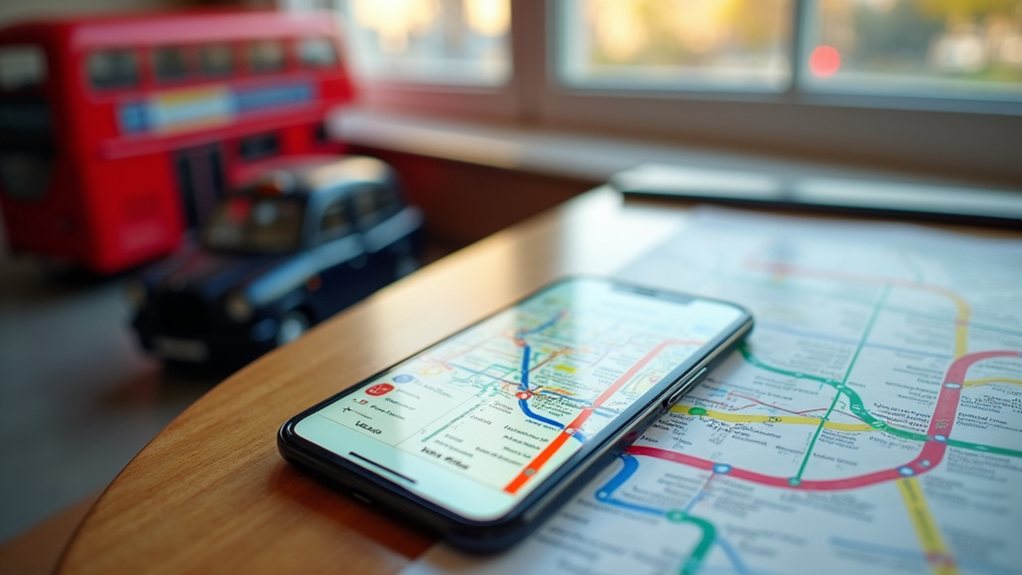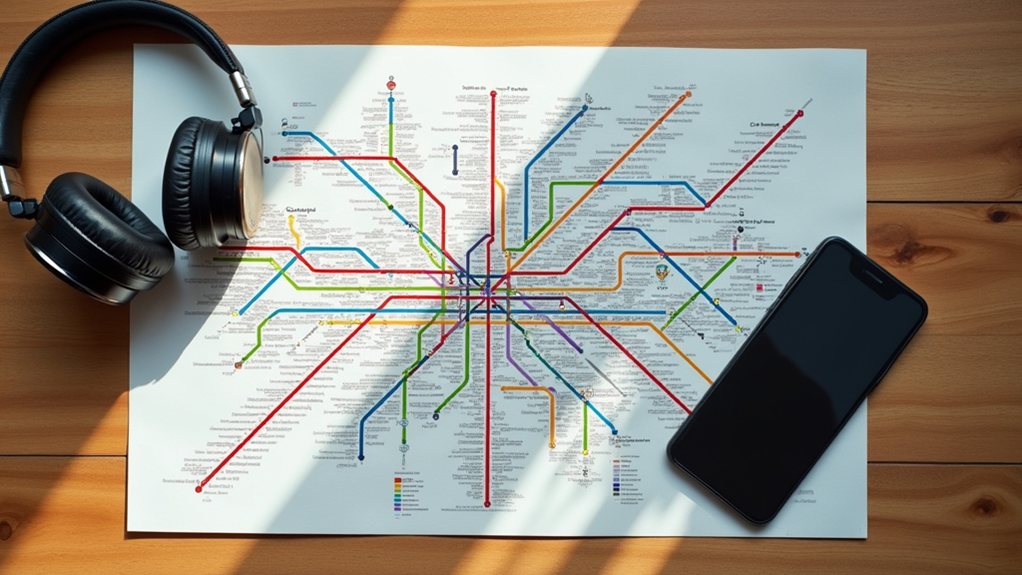
The London Tube map uses distinct colors for each line and symbols to mark stations and interchanges, helping users track routes easily. Stations are shown as small circles, with larger white circles indicating interchange points. Fare zones appear as shaded areas around station labels. The map includes multiple transit services beyond the Underground, like Overground and DLR. Travelers should focus on line colors and station names to plan efficient trips. Additional details clarify accessibility and connections for smoother navigation. Further guidance can deepen understanding of the system’s layout.
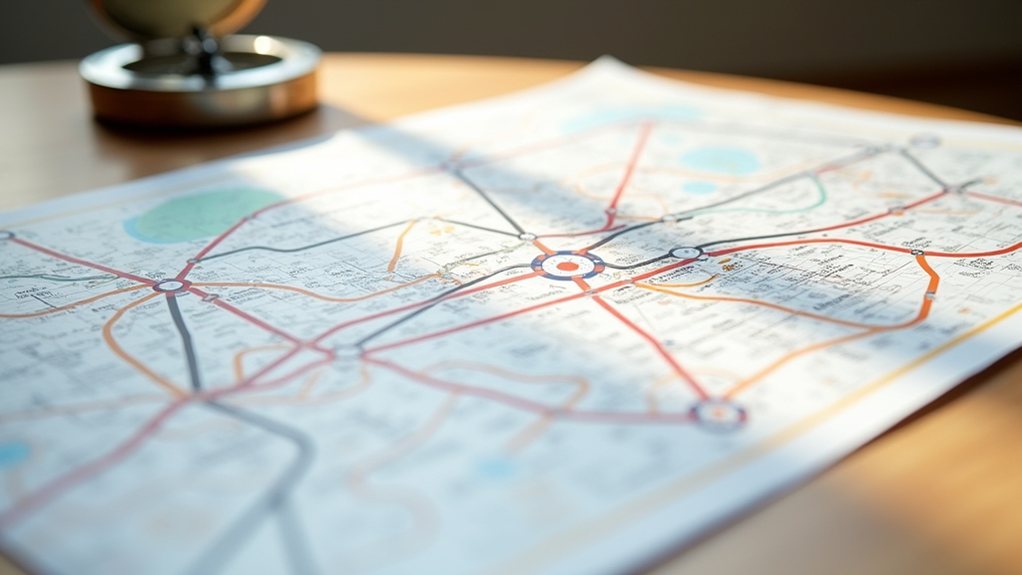
Although the London Tube map is not geographically accurate, it is designed to clearly show connections between stations and lines, making navigation easier for passengers. The map uses a diagrammatic layout, focusing on simplicity and readability rather than real-world distances or directions. The revolutionary design was first created by Harry Beck in 1931, marking a turning point in transit map design (diagrammatic map). It is essential for travelers to study the map before leaving their accommodation to avoid boarding the right line in the wrong direction (master tube travel).
It employs mostly horizontal, vertical, and 45-degree diagonal lines, which create a clear and organized structure. The central area of the map is enlarged compared to the outer sections, allowing busy zones with many stations to be easier to read. This layout, known as the “Journey Planner,” integrates various transport services, including the Tube, London Overground, DLR, Tram, TfL Rail, and the Elizabeth line. The original London Underground began operations in 1863 with the Metropolitan Railway, marking it as the world’s first underground railway system (first underground railway). Additionally, the London Transport Day Pass offers a convenient way to explore these services without worrying about individual fares.
Transport for London distributes the map free of charge in pocket and poster formats, and it is also available as downloadable PDFs.
Each Underground line is represented by a distinct colour, such as red for the Central line and black for the Northern line, which helps passengers quickly identify routes. Solid coloured lines show Underground lines, while orange-and-white and blue-and-white lines indicate London Overground and DLR services, respectively.
Where two lines share a track, the map shows both colours running alongside each other. Night Tube services and special routes appear on dedicated versions of the map or include additional symbols and keys. Line names are consistently used on station signage and the map, allowing passengers to match information on platforms easily.
Stations appear as small coloured circles or ticks, with names printed nearby for clarity. Interchange stations, where passengers can change lines, are marked by larger white circles with coloured borders or linked circles. Icons indicate connections to National Rail, DLR, and London Overground, while step-free access is shown using blue wheelchair symbols.
Fare zones are sometimes indicated by grey and white shading around station labels. Overall, the design emphasizes clear information to support efficient route planning and navigation.
Frequently Asked Questions
Are There Discounts for Children on the London Tube?
Children under 5 travel free on the London Tube when accompanied by a paying adult, with up to four children allowed per adult.
Children aged 5-10 also travel free but must be with an adult.
Those aged 11-15 receive a 50% discount using an 11-15 Zip Oyster photocard.
Teenagers aged 16-17 get half-price fares with a 16+ Zip Oyster photocard, which is required for any child-rate discounts on paid services.
Can I Use Contactless Payment on All Tube Lines?
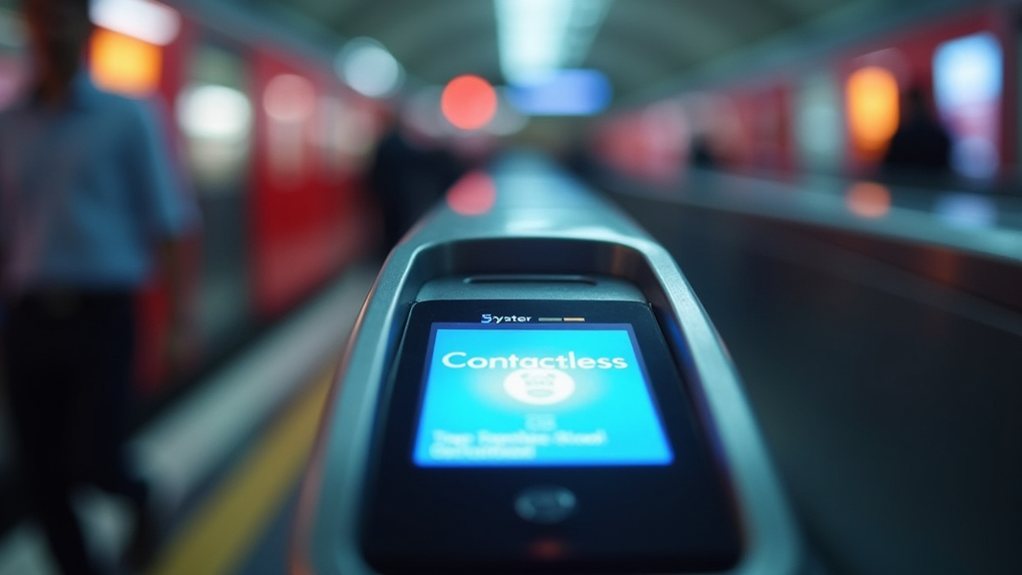
Contactless payment is accepted on all London Underground lines for pay-as-you-go travel.
It can be used at any gated Tube station with yellow card readers for touch in and out. Users must touch the same card or device at both entry and exit to avoid maximum fares and benefit from fare capping.
Contactless works across Zones 1 to 9, matching Oyster coverage, and supports debit, credit cards, mobile wallets, and wearables.
What Are the Operating Hours of the London Tube?
The London Tube operates generally from 5:00 AM to midnight, Monday through Saturday, with Sunday hours starting later around 7:00 AM and ending by 11:00 PM.
The Night Tube offers 24-hour service on specified lines only during Friday and Saturday nights.
Weekday peak hours are from 6:30 AM to 9:30 AM and 4:00 PM to 7:00 PM, with increased train frequency.
Passengers should check specific station times and closures, especially on weekends.
Are There Facilities for Disabled Passengers on the Tube?
Yes, the Tube provides extensive facilities for disabled passengers, including step-free access at over 90 stations, lifts, ramps, and wide-aisle ticket gates.
Trains have dedicated wheelchair spaces and priority seating. Stations feature tactile paving and clear signage, while audiovisual announcements assist sensory-impaired travelers.
Passenger Assist offers support without advance booking. The TfL Go app includes accessibility filters to plan routes, ensuring safer and easier travel for those with disabilities.
How Do I Report Lost Property on the London Tube?
Lost property on the London Tube should be reported through the TfL Lost Property online enquiry form, providing details such as description, date, time, and location.
Items are processed within 15 days. For items lost on buses within three days, contact the specific bus operator directly.
Credit cards and Oyster cards are not retained. If matched, TfL contacts the owner by email to arrange collection by appointment or courier, with items held for about two weeks.