
Few railway lines have experienced as many transformations as the East London Line, which began its life in 1869 when the East London Railway Company repurposed the famous Thames Tunnel for train travel.
The Thames Tunnel, designed by Marc Brunel, had originally been intended for horse-drawn carriages but opened as a pedestrian tunnel in 1843, attracting one million visitors in its first ten weeks. This engineering marvel came at a high cost, claiming the life of Brunel’s son during its construction in 1828. The tunnel was eventually sold to the East London Railway in 1865 for £200,000.
An engineering triumph that cost a life and drew crowds before becoming the backbone of East London’s railways.
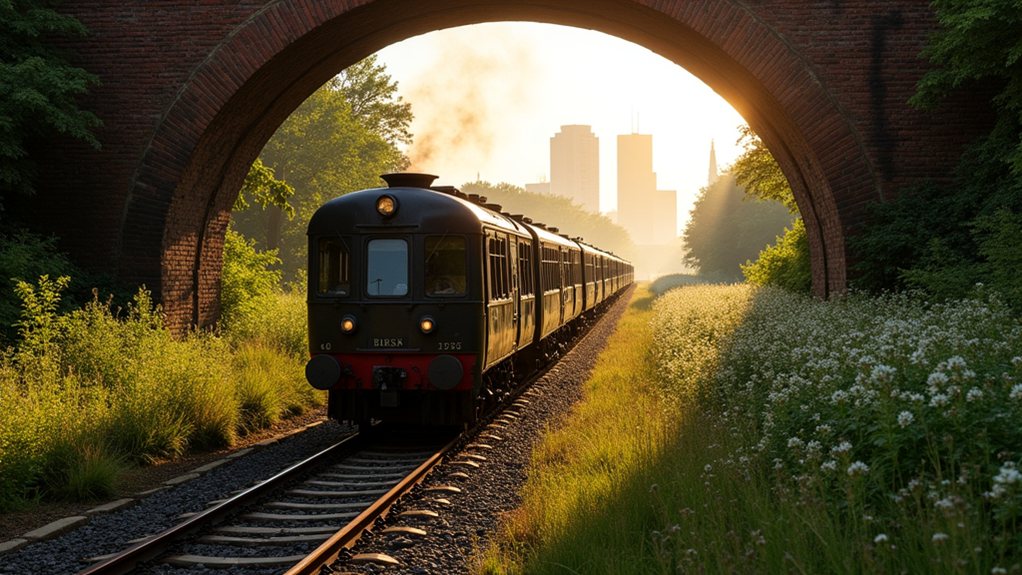
The line developed gradually, with the New Cross Gate section opening first in 1869, followed by a branch to London Docks in 1871. By 1876, the North London line connected to Shoreditch via Whitechapel, and a connection to Liverpool Street was established through the Great Eastern Railway. A spur to New Cross was added in 1880, further expanding the network’s reach across East London. Like the Edgware, Highgate and London Railway, this line utilized extensive viaducts to navigate challenging terrain across the city.
Several operational changes marked the line’s history. The Metropolitan District Railway electrified in 1905 but ceased using the line that July. The Metropolitan Railway suspended service after December 1906, though other operators continued. The line underwent significant improvement when full electrification was completed and electric services began operating on March 31, 1913.
In 1933, the line became part of the London Underground network, appearing on Tube maps in burgundy between 1934 and 1969, later changing to orange.
The line faced significant closures throughout its history. Passenger services via the 1884 spur ceased in 1939, and the Highbury-Shoreditch route closed to passengers in 1944. The entire line closed in December 2007 for extensive refurbishment, marking the end of one era and the beginning of another.
In April 2010, the line reopened as part of London Overground, extending to Clapham Junction by December 2012. This expansion created an orbital railway around inner London, breathing new life into a nearly forgotten line. Similar to Silvertown Station which had its tracks removed in 1980, the East London Line experienced periods of significant decline before its revitalization.
Today, with stations like Canada Water reopened, the East London Line continues its long history of connecting communities across the capital.