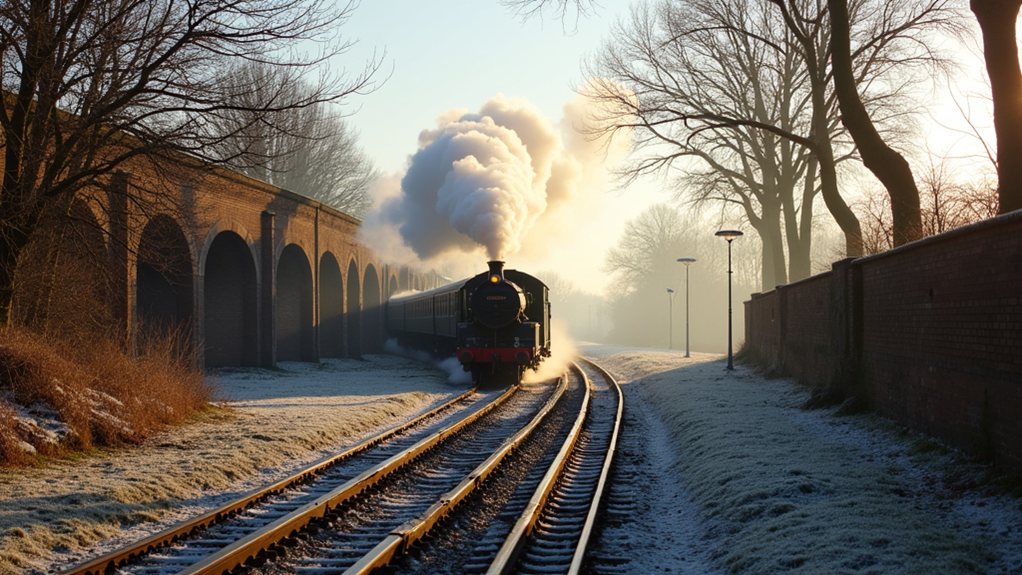

While many tourists flock to London’s famous Underground system, few visitors or even locals know about the historic Bow Curve, a remarkable piece of railway engineering that shaped East London’s development for over a century. This distinctive railway curve, opened by the London and Blackwall Extension Railway on April 2, 1849, was built on a viaduct connecting Gas Factory Junction to Bow and represents one of the earliest examples of urban railway infrastructure in the capital.
The curve formed a significant part of what would become the North London Railway, originally incorporated in 1846 as the East & West India Docks & Birmingham Junction Railway. This important transport link connected the bustling Poplar docks to Camden Town, establishing essential freight and passenger routes that helped power London’s rapid growth during the Victorian era.
Bow station, which opened in 1850, underwent significant rebuilding in the late 1860s to accommodate the curve’s construction within tight space constraints. The passenger numbers reflected the line’s importance, doubling to 14 million by 1866 and reaching an impressive 28 million by 1871. The North London Railway revolutionized transportation by introducing automated ticket machines in 1898 that allowed passengers to purchase third-class return tickets for just a penny.
A Victorian engineering marvel serving millions through London’s industrial heart while navigating the East End’s urban constraints.
Though passenger services ceased in 1944, the curve continued to serve freight traffic until 1984. Today, only fragments of this historic railway remain visible. The original Bow station site now houses a bookmaker’s shop marked with a commemorative plaque.
Careful observers can spot track remnants near Bow Road DLR station, an old bridge under Springfield Close flats, and subtle road inclines that mark former alignments.
On January 18th, railway enthusiasts will have a rare opportunity to explore this historic infrastructure during a guided walking tour. The tour will trace the curve’s path from its western junction, following the viaduct route to the former Bow Road station site.
Participants will learn about the curve’s significant role in London’s transport development and how the Docklands Light Railway later reused parts of its southern alignment, restoring passenger services from Poplar to Bow in 1987. The station originally featured an impressive concert hall that could accommodate 1,000 people, highlighting its importance as a community hub beyond just transportation. At its peak in the early 1900s, the North London Railway served an impressive 85,000 daily passengers before competition from trams and underground railways began to impact ridership.