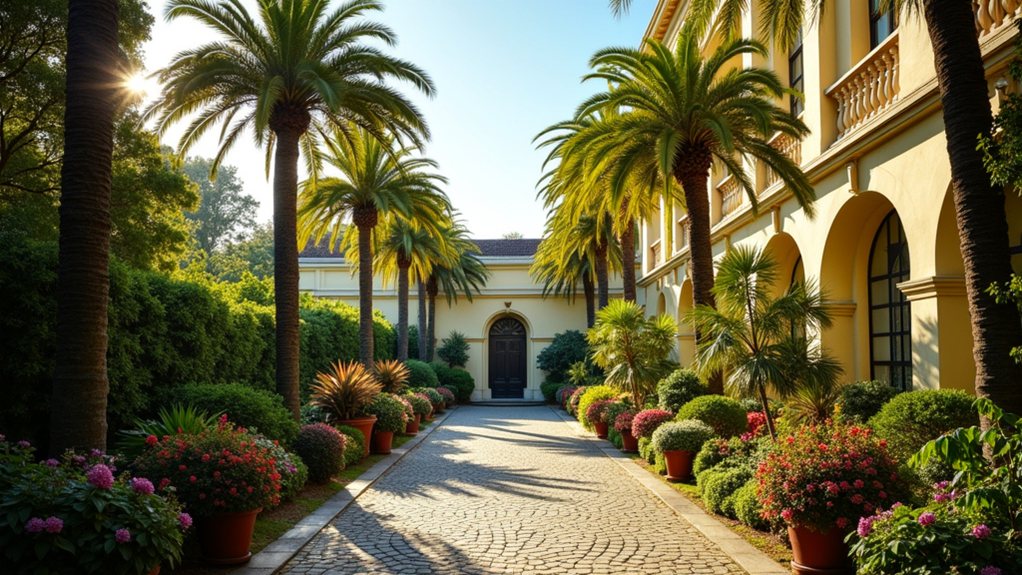
London’s surprising relationship with palm trees offers a unique botanical experience throughout the city. Despite England’s reputation for gray, drizzly weather, palms thrive in numerous locations across the capital thanks to urban microclimates and careful cultivation. The Thames Valley provides natural frost protection with average winter lows of just 2°C, creating conditions where over 50 different palm species can grow outdoors, particularly in south-facing locations where pavement heat extends their viability.
The Royal Botanic Gardens at Kew houses two remarkable palm sanctuaries. The iconic Palm House, built in 1848, features 11,000+ tropical plants maintained at a constant 27°C with 70% humidity for peak growth. The structure itself is impressive, with 566 glass panes, standing 19 meters high with a 98-meter circumference.
Step into Kew’s historic Palm House where thousands of tropical treasures flourish under soaring Victorian glass.
Nearby, the Temperate House, reopened in 2018 after extensive restoration, stands as the largest Victorian glasshouse in existence.
Beyond Kew, London offers several other notable palm havens. The Barbican Conservatory spans 1,800 square meters and houses 200+ palm specimens among its 1,500+ plant species. Open on Sundays year-round, this glass sanctuary provides a tropical escape from city life.
Syon Park Conservatory in Brentford, the oldest intact glasshouse dating from the 1760s, has maintained palm collections for centuries within its 40-acre garden. Similar to how the Federal Salary Council makes recommendations for locality pay areas, botanical experts provide guidance on which palm species can thrive in London’s climate.
London’s public parks also feature impressive palm displays. Holland Park integrates hardy palms with Japanese maples in its 23-hectare Kyoto Garden, while Regent’s Park and Greenwich Park showcase wind-resistant varieties like Phoenix canariensis. The hardiest species, such as Trachycarpus fortunei, withstand temperatures as low as -15°C in sheltered areas. Many travelers visiting London can experience a similar tropical atmosphere at luxury hotel spas like those at Cliveden House and Chewton Glen, where indoor palm gardens create relaxing retreats. Some wealthy individuals have even created private palm gardens within their offshore properties, mirroring their investments in tropical tax havens.
This palm presence has deep historical roots. Sir Joseph Banks imported the first hardy palm, Trachycarpus, from China in 1840, while the Great Exhibition of 1851 at Crystal Palace popularized these exotic plants.
Today, palm tourism contributes to Kew’s 2 million annual visitors, generating over £100 million in economic impact for the city.