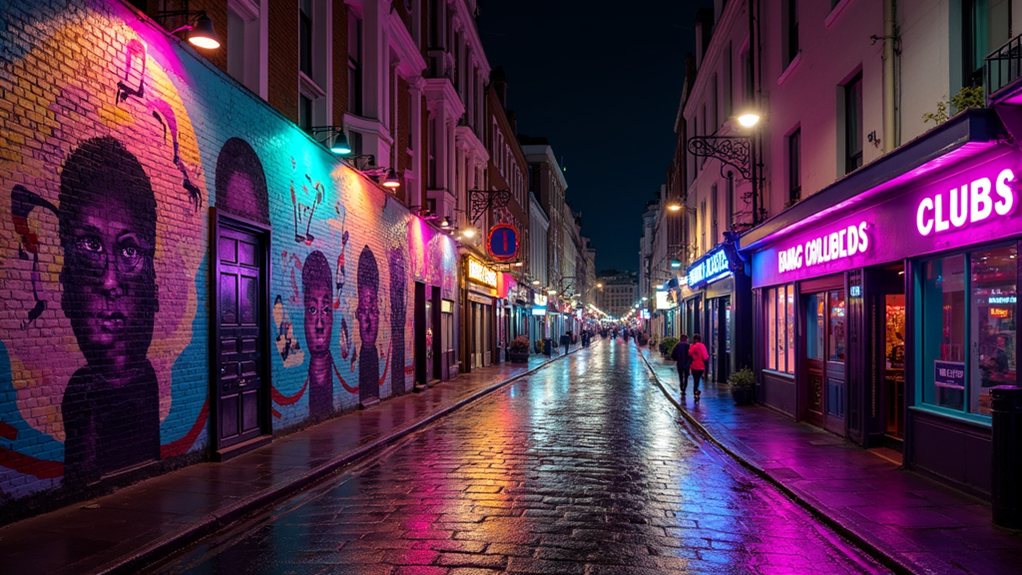
Three decades of Black queer nightlife in London have shaped a vibrant yet vulnerable cultural landscape that continues to evolve despite numerous challenges. Figures like Valerie Mason-John, who emerged as a vital activist in the early 1990s, helped establish spaces where Black lesbian representation flourished.
Similarly, DJs like Chris McCoy and Mark Moore created community connections through music that transcended simple entertainment, fostering cultural networks that supported marginalized identities.
Music became more than entertainment—it was the invisible architecture of community for those existing on society’s margins.
The roots of these communities extend back to the interwar period, when foundational connections formed between Black queer communities in London, Harlem, and other transatlantic cities. These historical links created cultural exchange pathways that continue to influence contemporary nightlife scenes, despite their absence from mainstream LGBTQ+ narratives.
London’s queer venues have faced devastating losses, with nearly 60% closing between 2006 and 2017. This decline from 125 to 53 venues has disproportionately impacted spaces catering to Black, Asian, and minority ethnic LGBTQI communities. Recent research by Dr Ben Campkin and Dr Lo Marshall has documented how this venue reduction trend especially affects women and BAME communities.
The Elizabeth Line construction further decimated Soho, demolishing iconic venues like First Out café and the London Astoria. Historical spaces like the Caravan Club represented vital gathering places for both queer people and people of color before their disappearance.
These closures reflect broader patterns of inequality, where intersectional vulnerability makes certain communities more susceptible to displacement. Black queer nightlife developed amid racial exclusion, homophobia, and economic challenges, creating distinct cultural expressions that now face erasure through gentrification and commodification.
Rising property values in central London have made many queer venues economically unsustainable. Additionally, restrictive policies around noise pollution and building modifications have intensified financial pressures.
The change of 30% of previously queer London venues into non-LGBTQ+ specific premises represents significant cultural loss.
Digital platforms like dating apps have contributed to venue decline, changing how communities connect.
Despite these challenges, Black queer pioneers continue working to preserve spaces where their cultural distinctiveness can thrive. The case of The Black Cap exemplifies this persistence, with a dedicated campaign maintaining weekly vigils for nearly a decade since its 2015 closure. Their efforts highlight the ongoing importance of physical venues as sites of resistance, celebration, and community-building within the transatlantic Black queer cultural exchange.