
Innovation has long driven the evolution of personal transportation, with electric scooters representing one of the most significant developments in urban mobility. The journey toward modern electric scooters began in the 1830s with Kirkpatrick Macmillan‘s velocipede, a two-wheeled device that laid the groundwork for future developments.
By the late 19th century, inventors were already experimenting with electric bicycles, filing patents in 1895 that demonstrated early interest in electric personal transport.
Electric innovation sparked as early as 1895, with visionaries laying groundwork for the transport revolution we witness today.
A pivotal moment came in 1913 when Henry K. Wills introduced the Autoped, one of the first commercially produced motorized scooters. The gasoline-powered Autoped featured a small engine mounted between wheels, a step-through deck, and handlebar-mounted controls—a design that would influence scooter development for decades to come. This innovative scooter marked a significant shift from pedal-driven vehicles to motorized transportation options.
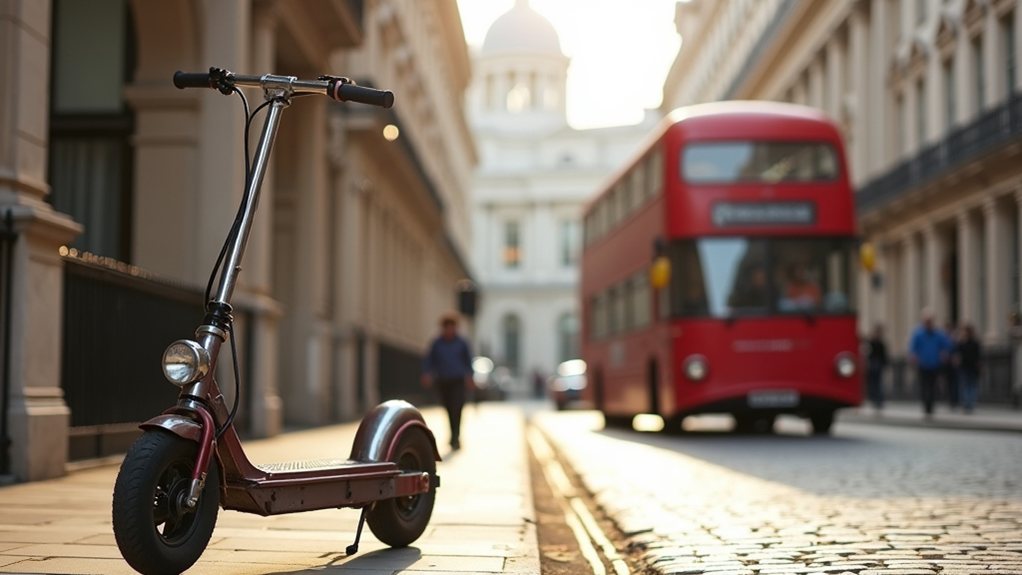
In London and other cities, the Autoped proved its practical value as delivery services and municipal workers adopted it for short urban trips.
Throughout the interwar and postwar periods, small electric vehicle experiments maintained technical continuity toward later electrification. In 1974, Auranthic Corp. produced the Charger motorcycle with 48 km/h top speed and impressive 80 km range. The true breakthrough came in 1996 with Peugeot’s Scoot’Elec, recognized as the first mass-produced electric scooter.
Using nickel-cadmium batteries, it offered a range of approximately 25 miles, making it practical for city commuting.
The early 2000s saw companies like Zap and Razor introduce consumer electric scooters that helped popularize personal micromobility. Advancements in battery technology—progressing from nickel-cadmium to nickel-metal hydride and eventually to lithium-ion—significantly improved range, reduced weight, and lowered costs of electric scooters.
London’s electric scooter story gained momentum in the late 2010s when dockless sharing startups like Bird and Lime deployed their vehicles in cities worldwide. These services revolutionized urban mobility by offering dockless scooter sharing through smartphone applications, making electric scooters more accessible than ever before.
The Department for Transport’s decision to permit national scooter trials opened a regulatory pathway for London and other UK cities.
Today’s electric scooters in London streets represent the culmination of over a century of innovation, from the pioneering Autoped to modern shared micromobility services that are reshaping urban transportation.