Many London Underground stations have undergone name changes throughout their history, reflecting evolving priorities in transportation management and public communication. These transformations often prioritize simplicity and operational efficiency over historical or etymological accuracy, creating a more streamlined passenger experience across the network.
One notable example is Seven Sisters station, which originally bore the descriptive name “Seven Elms in a Ring around a Walnut Tree.” This lengthy designation, while geographically accurate, presented significant challenges for transit announcers and confused travelers unfamiliar with the area. Transport authorities ultimately shortened it to the more manageable “Seven Sisters,” exemplifying London Underground’s naming efficiency initiative.
Similar practical considerations drove other station renamings. Oxford Circus, previously known as “Earl of Oxford’s Roundabout,” underwent condensation to improve orientation and station recognition while maintaining its geographical reference. This pattern of abbreviating multi-word identifiers into concise two-word names has become standard practice throughout the Underground system.
The evolution of Paddington Station demonstrates how linguistic transformation occurs over time. Its original Anglo-Saxon designation “Padda’s Farm” gradually morphed into the modern “Paddington,” preserving historical connections while enhancing accessibility for contemporary users. This change represents a broader pattern of Anglo-Saxon place names being modernized throughout London.
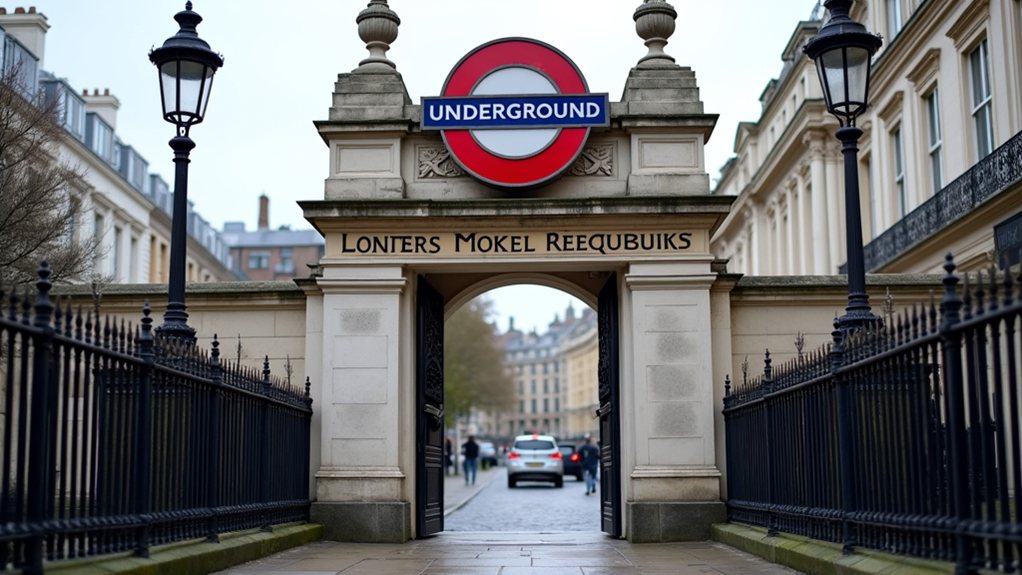
Farringdon Station exemplifies how relocations and expansions can trigger name changes. Initially established as “Farringdon Street,” the station underwent multiple naming iterations following its 1865 relocation, finally settling on simply “Farringdon” in 1936. Station websites sometimes experience traffic overload issues during peak travel periods when numerous passengers simultaneously seek information. These adjustments reflected the station’s evolving role within London’s expanding transportation network. The station now serves as a crucial junction for multiple lines including the Hammersmith & City, Circle, and Metropolitan. The iconic roundel and Johnston typeface, created in 1916, have become essential elements of the Underground’s visual branding across all station signage.
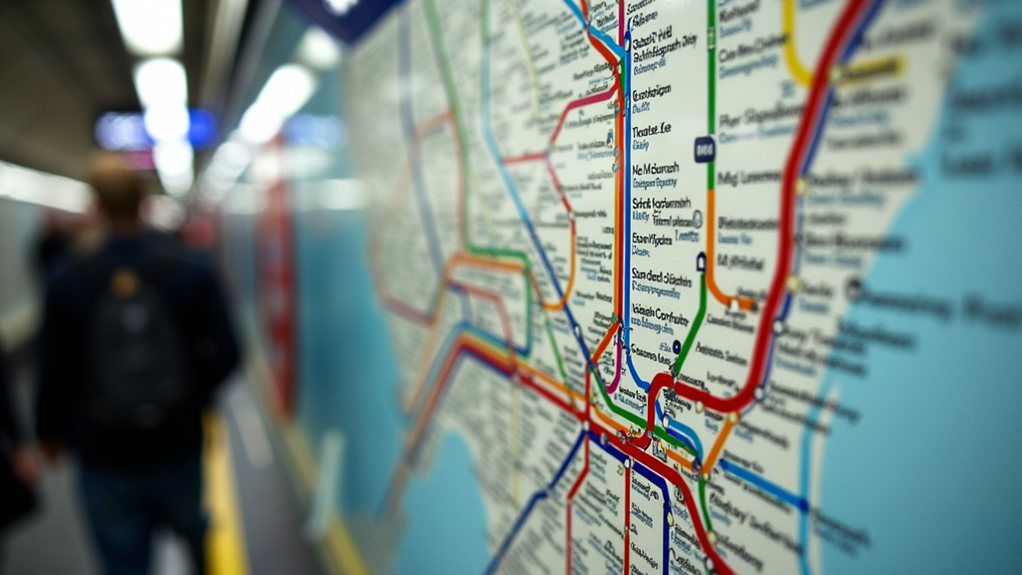
Recent etymological research by writer Mark Forsyth and designer Mark Noad has illuminated the origins behind every tube station name, revealing patterns influenced by Anglo-Saxon settlers, nobility references, and geographical features.
Their thorough map demonstrates how London’s transport nomenclature balances historical significance with practical communication needs, ultimately favoring simplicity to serve the millions of passengers navigating the system daily.