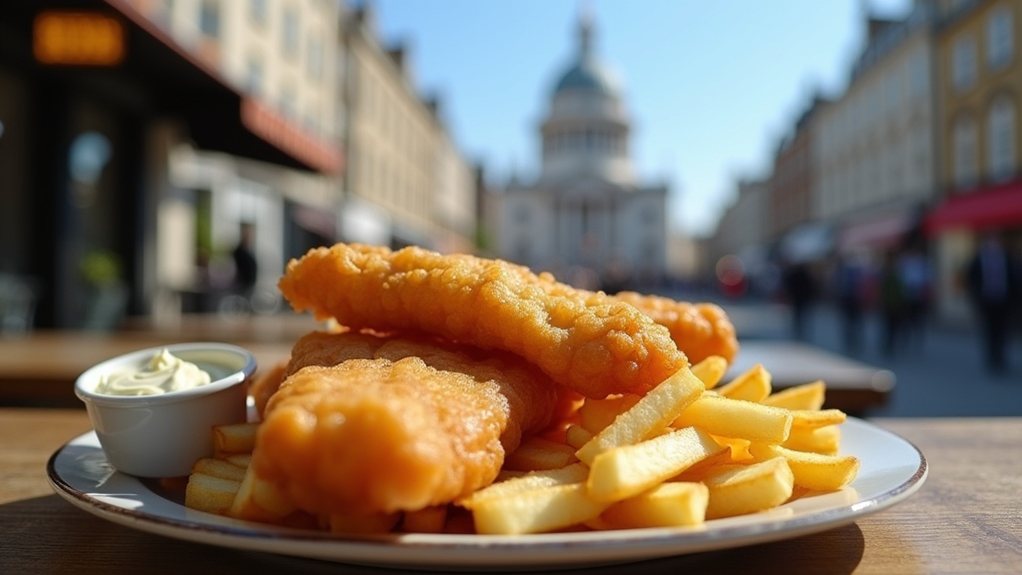

The quintessential British dish of fish and chips traces its origins to 19th-century London, where it emerged as a beloved national staple. This iconic pairing developed from two distinct culinary traditions: fried fish, introduced by Jewish immigrants from Spain and Portugal via the Netherlands between the 16th and 19th centuries, and chips, which derived from potatoes brought to England in the 17th century by Sir Walter Raleigh.
Charles Dickens even referenced a “fried fish warehouse” in his 1839 novel Oliver Twist, highlighting the dish’s early popularity.
Even Dickens recognized the beloved status of fried fish in London’s culinary landscape, mentioning it in Oliver Twist.
The first recorded fish and chip shop opened in London’s East End around 1860, established by Ashkenazi immigrant Joseph Malin. The National Federation of Fish Friers recognized Malin’s establishment as the world’s first fish and chip shop, though competing claims exist from northern England, where John Lees opened a shop in Mossley, Lancashire, in 1863. Malin’s shop was reportedly located within the sound of Bow Bells, either on Cleveland Street or in Bow.
Jewish immigrants greatly influenced this British culinary tradition, bringing their pescado frito (batter-fried fish) to London. Initially, fried fish was sold on London streets in the “Jewish fashion,” particularly for the Sabbath. As immigration peaked in the 1850s in London’s East End, the tradition of Friday fried fish spread beyond the Jewish community to become a national custom.
Early fish and chip establishments operated as small family businesses, often run from the front rooms of houses. By the late 19th century, these shops had become commonplace across the United Kingdom.
Samuel Isaacs elevated the experience by opening the first sit-down fish restaurant in Lambeth in 1896. The industry has over 500 traditional Jewish recipes that mention various ways to prepare fish and chips, showing its deep cultural connections. During World War II, fish and chips played a crucial role in maintaining British morale as it was among the few foods never rationed. These shops saw long queues whenever fish became available during wartime shortages. Today, Rock & Sole Plaice in Covent Garden, operating since 1871, stands as London’s oldest fish and chip shop.
The preparation methods remained relatively consistent through the years, with fish typically battered using flour mixed with water or beer, then fried in oil. White fish, usually cod or haddock, became the standard choice, served alongside chips cut from potatoes, creating the perfect pairing that continues to delight visitors to London.