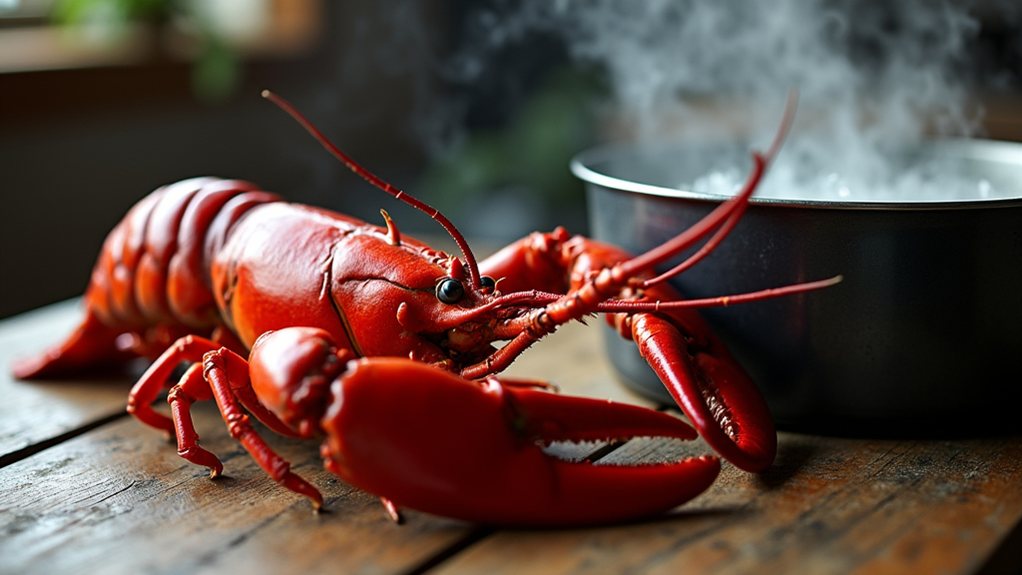
While chefs across England have long prepared lobsters by dropping them live into boiling water, this traditional cooking method faces an uncertain future. In December 2025, the Labour government announced plans to ban the practice of boiling decapod crustaceans alive as part of a broader animal welfare strategy for England. The Environment Secretary’s proposal specifically targets lobsters, crabs, and similar crustaceans, but not finfish.
The ban stems from growing concerns about animal welfare and scientific research suggesting that crustaceans may experience pain when boiled alive. Although scientists continue to debate the exact nature of pain perception in these creatures, the government has adopted a precautionary approach, deeming live boiling “not an acceptable killing method” despite ongoing scientific uncertainty.
Scientific uncertainty hasn’t prevented government action—live boiling is deemed unacceptable while research on crustacean pain perception continues.
For London’s restaurant industry, the proposed ban presents significant operational challenges. Chefs and restaurant owners have voiced concerns about enforcement difficulties in busy kitchens and potential increases in preparation time. The hospitality sector, already facing workforce shortages, worries about the additional strain of implementing alternative methods. Chef Aldo Zilli emphasizes the need for responsible sourcing while balancing regulatory compliance.
Several humane alternatives exist, including electric or mechanical stunning equipment, freezing to induce insensibility, or using knife techniques to rapidly destroy the central nervous system. However, smaller restaurants have flagged the disproportionate burden they face compared to larger operations when purchasing expensive stunning equipment.
Adding to the uncertainty, the Department for Environment, Food and Rural Affairs (DEFRA) has yet to publish final regulations, enforcement details, or penalty regimes. Questions remain about how compliance will be verified in fast-paced commercial kitchens and what sanctions might apply to violations.
The proposed ban aligns with similar measures in other countries reassessing humane killing methods for invertebrates in food chains. For effective implementation, restaurants will need validated procedures, staff training, and possibly third-party certification.
As the consultation period continues, London’s culinary scene watches closely to see how this animal welfare initiative will reshape traditional seafood preparation.