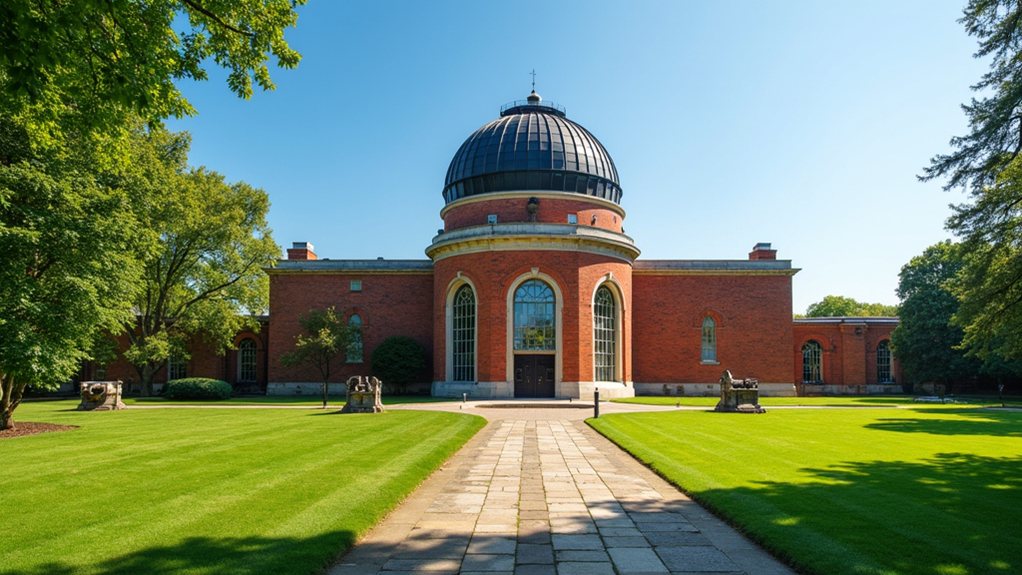

Greenwich Royal Observatory is a treasure trove of history and science, famous for the Prime Meridian line splitting east and west hemispheres. Visitors can stand in two hemispheres at once and glimpse the dazzling green laser marking the line at night. The Flamsteed House, designed by Sir Christopher Wren, houses pioneering astronomical tools and John Harrison’s sea clocks, solving longitude puzzles at sea. The giant Great Equatorial Telescope and Shepherd Gate Clock make timekeeping feel alive and tangible. Explore further to uncover even more wonders.
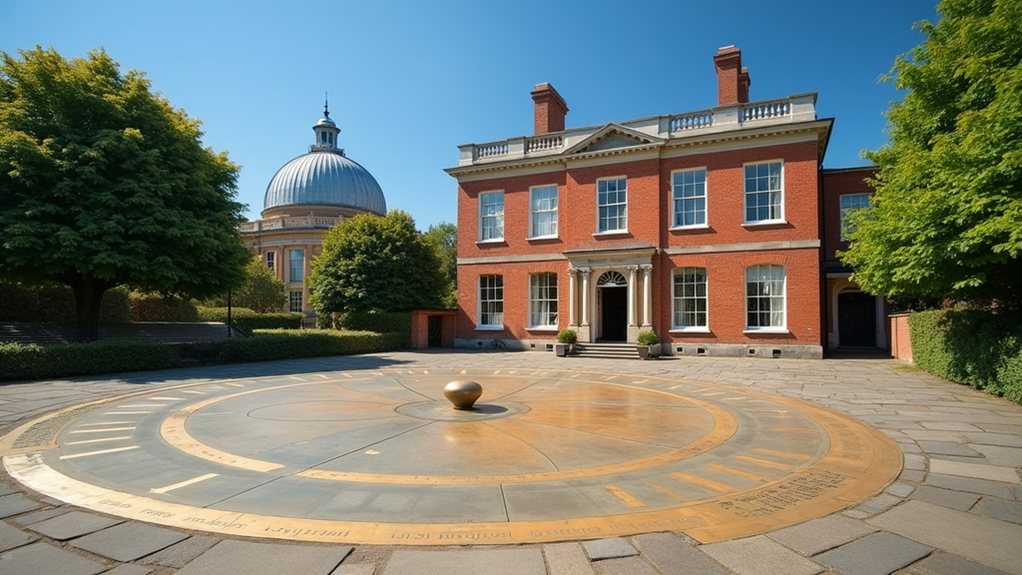
Although it may seem like just a historic building, the Greenwich Royal Observatory holds a world of fascinating stories and groundbreaking discoveries that have shaped how humanity measures time and explores the stars. One of its most famous features is the Prime Meridian line, set at longitude 0° 0′ 0″, which was formally adopted as the global reference point at the International Meridian Conference in 1884. This line divides the eastern and western hemispheres, and visitors can enjoy the unique experience of standing with one foot in each hemisphere at the Meridian Courtyard. At night, a green laser beam shoots across the London sky, marking this invisible but essential line—a light show with a scientific twist.
Greenwich Royal Observatory: where timekeeping history and the Prime Meridian unite the world’s hemispheres.
The observatory’s history stretches back even further with Flamsteed House, designed by Sir Christopher Wren and completed in 1676. Commissioned by King Charles II, this building was intended to improve navigation by studying the stars. The Octagon Room, the oldest part of the observatory, once housed early astronomical instruments and precision clocks, and now serves as a gallery to showcase the pioneering work of the Astronomers Royal. Situated in Greenwich it stands as the home of British astronomy. Large windows allowed multiple telescopes to peer into the heavens, emphasizing the significance of observation. Visitors can also explore the Octagon Room, which offers interactive learning opportunities about the observatory’s history and astronomy. However, visitors may occasionally experience limited access due to server connection problems when trying to explore online resources. The observatory also plays a vital role in the development of navigation.
Timekeeping innovations are a highlight, especially the collection of John Harrison’s marine timekeepers. These clocks, developed to solve the long-standing longitude problem at sea, revolutionized navigation by enabling sailors to calculate their east-west position accurately. The display includes Harrison’s famous H1 to H4 chronometers, tracing the evolution of reliable sea clocks. Also featured is the F.M. Fedchenko clock, renowned for its remarkable accuracy. The observatory’s galleries tell the broader story of how astronomy and navigation have intertwined to create global timekeeping standards.
Adding to its scientific prestige is the Great Equatorial Telescope, installed in 1893. This massive refractor, about eight meters long with a 71 cm aperture, is housed under an onion dome and remains in use for special observations. Alongside it, the Airy Transit Circle telescope, installed in 1850, played a significant role in defining the Prime Meridian through more than 600,000 observations. Visitors can also admire the Shepherd Gate Clock, one of the earliest electrical clocks showing Greenwich Mean Time on a 24-hour dial, and the Greenwich Time Ball, which historically provided a public time signal. Together, these features make the Greenwich Royal Observatory an enchanting place where history, science, and timekeeping come alive.
Frequently Asked Questions
What Are the Greenwich Royal Observatory’s Opening Hours?
The Greenwich Royal Observatory opens daily from 10:00 to 17:00, with last entry at 16:15, giving visitors about 45 minutes to soak in the wonders before closing.
Summer months extend hours, sometimes until 19:45, perfect for night owls!
Remember, it closes on December 24–26, so no Christmas star-gazing then.
Checking current times online is wise—after all, even timekeepers need a break or a schedule tweak now and then!
Is There an Admission Fee to Enter the Observatory?
Yes, there is an admission fee to enter the observatory.
Adults pay £24, while children aged 4–15 get in for £12, and students with ID pay £18. Little explorers under 4 enter free, which is a nice bonus for families.
Planetarium tickets are extra, so budget accordingly. Discounts apply for certain groups, and combo passes with nearby attractions offer savings.
Booking ahead is wise to avoid disappointment—spaces fill up faster than a telescope lens at midnight!
Are Guided Tours Available at the Observatory?
Yes, guided tours are offered daily, featuring the popular Treasures Tour that explores key historic instruments and stories in about an hour.
These tours start near the Dolphin Sundial at 11:00 and 15:00, costing around £5 for adults.
For early birds, Golden Tours offers exclusive early-access visits.
Audio guides in many languages provide a self-paced alternative, ensuring everyone can enjoy the observatory’s cosmic wonders without getting lost in space—or time!
Is the Observatory Wheelchair Accessible?
The observatory offers partial wheelchair accessibility, meaning some areas like the Prime Meridian courtyard and planetarium are easy to explore on wheels.
However, older buildings with narrow doorways or stairs, such as Flamsteed House, pose challenges.
Steep hills and uneven paths in Greenwich Park add a bit of adventure, but a helpful buggy service makes uphill trips smoother.
Accessible toilets, ramps, and free manual wheelchairs enhance the visit, proving the observatory tries hard to welcome everyone.
Can I Book Private Events at the Observatory?
Yes, private events can be booked at the observatory, offering a unique celestial backdrop for occasions like weddings, corporate dinners, or summer parties.
Spaces range from the intimate Octagon Room for up to 60 guests to the Peter Harrison Planetarium seating 130 for presentations.
Extras like private telescope viewings or planetarium shows add starry magic.
The venue team customizes each event, ensuring it’s as memorable as a night under the stars—literally!