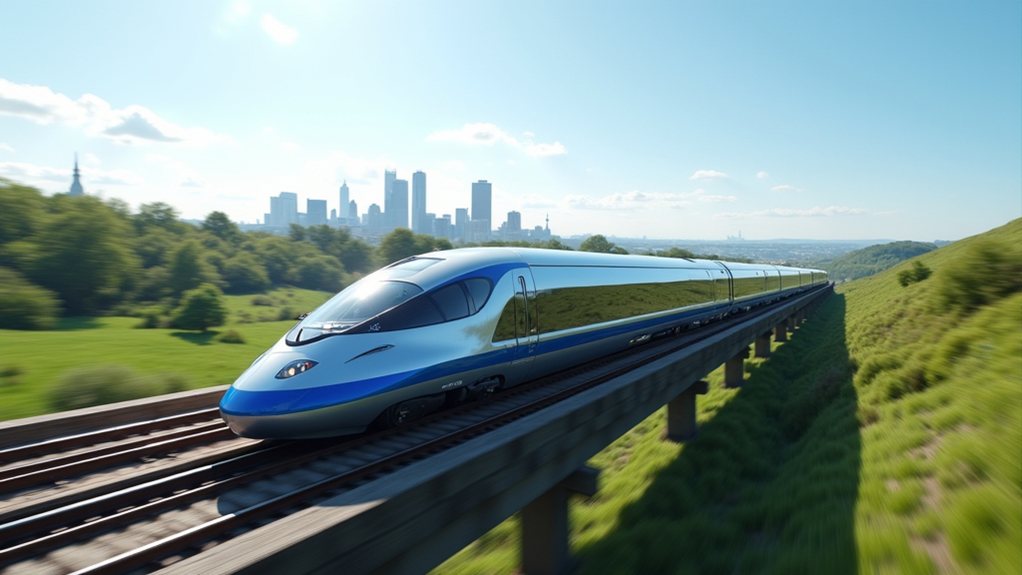

While controversial plans for a cutting-edge magnetic levitation rail system across the United Kingdom have stalled, proposals once suggested that journeys between London and Edinburgh could be slashed to just 60 minutes. The ambitious UK Ultraspeed project, which ceased promotion efforts in early 2013, envisioned a high-speed maglev network connecting 16 major stations between London and Glasgow, with Edinburgh as a key stop along the route.
The proposed maglev trains would have reached inter-city speeds of up to 500 km/h (310 mph), dramatically reducing travel times compared to conventional rail. Currently, trains between London and Edinburgh take approximately 4-5 hours, but UK Ultraspeed claimed its technology could complete the London-Glasgow journey in just 160 minutes including all stops, suggesting a London-Edinburgh time of around 60 minutes would have been achievable. Such high-speed travel would have fundamentally shifted the mindset regarding distance, making these long journeys feel as accessible as city-based transfers.
Ultraspeed’s 310 mph maglev trains promised to transform the 4-5 hour London-Edinburgh journey into a mere 60-minute trip.
These maglev proposals extended beyond the main London-Glasgow line. A separate project specifically targeted the Edinburgh-Glasgow corridor, promising to cut the commute between Scotland’s two largest cities to just 18 minutes at speeds of 300 mph, compared to the current ScotRail journey of around 50 minutes. The elevated guideway design would have minimized land use impact while maintaining comparable construction costs to conventional rail systems. This shorter route would have included stops at Edinburgh Airport with four shuttles per hour in each direction.
The technology was modeled after Shanghai’s maglev, which covers 30 km in 8 minutes at speeds originally reaching 268 mph. UK Ultraspeed projected significant time savings across its network, with London-Manchester reduced from 128 minutes to 54 minutes and London-Birmingham from 84 minutes to 30 minutes. Safety concerns emerged following the 2006 Lathen collision, casting doubt on the reliability of the Transrapid technology proposed for the UK system.
Despite the potential speed revolution, the financial requirements proved challenging. The full UK Ultraspeed network carried a projected cost of £29 billion, including guideways, land acquisition, and 27 train sets. The Edinburgh-Glasgow segment alone was estimated at £2 billion.
The UK government ultimately rejected the maglev proposals in 2007, favoring conventional high-speed rail through the High Speed 2 project, which offers improved but comparatively slower journey times.