While most Londoners go about their daily lives without considering catastrophic scenarios, understanding how to navigate England’s sprawling capital during an emergency could mean the difference between life and death. COLAB Tower’s immersive “London’s Chilling Apocalypse Adventure” puts participants to the test, exploring evacuation routes and survival tactics specifically tailored to London’s unique urban landscape.
The experience emphasizes London’s transportation advantages, highlighting the Heliport at Battersea for aerial evacuation and St Katherine’s Docks for water-based escape. Participants learn how the River Thames serves as an essential escape corridor, with vessels potentially commandeered for escape to the North Sea. The historic HMS Belfast, with its D-Day bombardment defenses, represents an overlooked shelter option. Additionally, the Battersea Park Children’s Zoo provides a potential refuge due to its diverse animal population and secure environment.
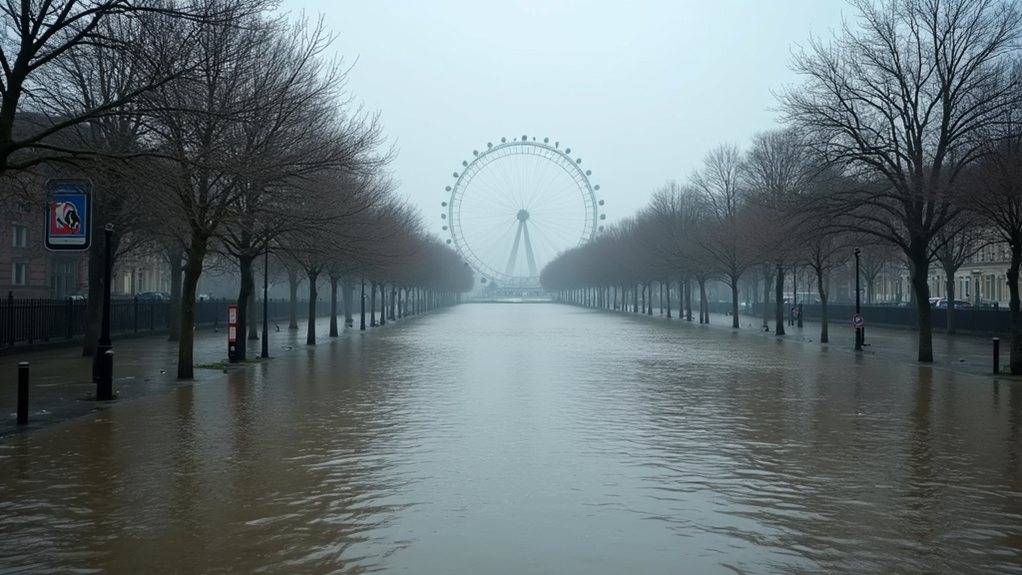
London’s waterways provide crucial evacuation options, with the Thames serving as a lifeline to the North Sea during emergencies.
Urban infrastructure knowledge proves significant, with high-rise buildings offering safety above street-level chaos. London’s extensive sewer system enables hidden movement throughout the city, while office buildings provide opportunities for barricading. The adventure notes that while the Underground might seem ideal, it quickly becomes hazardous during emergencies.
The experience realistically addresses London’s defensive weaknesses, including its flat terrain and sprawling layout that create vulnerabilities. The absence of natural barriers and endless urban sprawl require strategic thinking for survival. With a population of nearly 10 million people, London presents heightened risk during an undead outbreak.
Practical equipment recommendations focus on immediately useful items: warm clothing, waterproofs, and sturdy hiking boots. Participants learn how satellite GPS devices become essential as power grids fail, and how to purify water using iodine tablets or sun exposure. The simulation teaches participants to establish squad management systems for effective resource gathering and defense against the hordes of infected.
Improvised weapons like metal pipes, umbrellas, and cricket bats represent accessible self-defense options in a city with strict weapon laws. Fire-starting techniques using common items like chapstick, Vaseline, and hairspray form a core component of the adventure. Recent studies show that despite their interest in apocalypse media, only one in four Brits actually have a vague escape plan ready.
Participants also discover unconventional uses for everyday items, such as unravelled tampons for medical dressing or fire kindling. The experience concludes with sobering statistics: the average unprepared British adult might survive just nine weeks during a catastrophic scenario, emphasizing the importance of strategic planning.