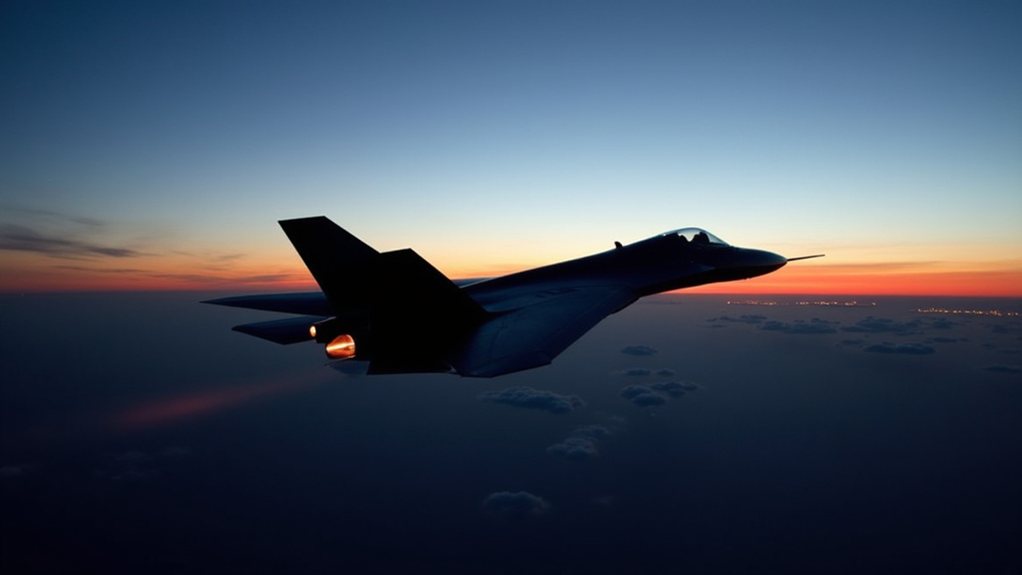

How did a jet nicknamed “the Blackbird” become the fastest air-breathing aircraft in history? The answer lies in its remarkable design and performance capabilities that pushed the boundaries of aviation technology.
The SR-71, with its distinctive titanium airframe coated in matte black paint, was built to fly higher and faster than any other aircraft of its time, setting records that remain unbroken decades later.
The Blackbird’s incredible speed came from its two Pratt & Whitney J58 afterburning turbojet engines, each producing 32,500 pounds of thrust in the JT11D-20J variant. Unlike conventional aircraft, the SR-71 operated with its engines in continuous afterburner during supersonic cruise, allowing it to maintain speeds exceeding Mach 3.2, or over 2,200 mph at altitudes of 80,000 feet.
Twin J58 engines in constant afterburner propelled the SR-71 beyond Mach 3.2, shattering conventional flight limitations.
This extraordinary performance enabled the SR-71 to set numerous records, including an astonishing New York to London flight completed in just 1 hour and 55 minutes. With a maximum takeoff weight of 172,000 lb, the aircraft required special considerations for fuel loads on these record-breaking international flights. The first operational sortie of this remarkable aircraft was flown from Kadena AB on March 21, 1968. Flying at more than three times the speed of sound, the Blackbird could survey approximately 100,000 square miles per hour from its cruising altitude, making it an unparalleled reconnaissance platform.
The aircraft’s design was equally impressive, featuring a wingspan of 55 feet 7 inches and an empty weight of 67,500 pounds. When fully loaded, it weighed 170,000 pounds, requiring a two-person crew consisting of a pilot and reconnaissance systems officer to operate its sophisticated systems.
Throughout its operational history until retirement by the US Air Force on January 26, 1990, the SR-71 maintained its status as the world’s fastest air-breathing manned aircraft. The aircraft was developed by Skunk Works, a secretive division of Lockheed Martin, during the height of Cold War tensions.
Its absolute speed record of 2,193.167 mph and altitude record of 85,068.997 feet demonstrate the remarkable engineering achievement it represents.
The epic dash across the Atlantic stands as a showcase of American aerospace innovation, showcasing the Blackbird’s unmatched capabilities and cementing its place in aviation history as one of the most extraordinary aircraft ever built.